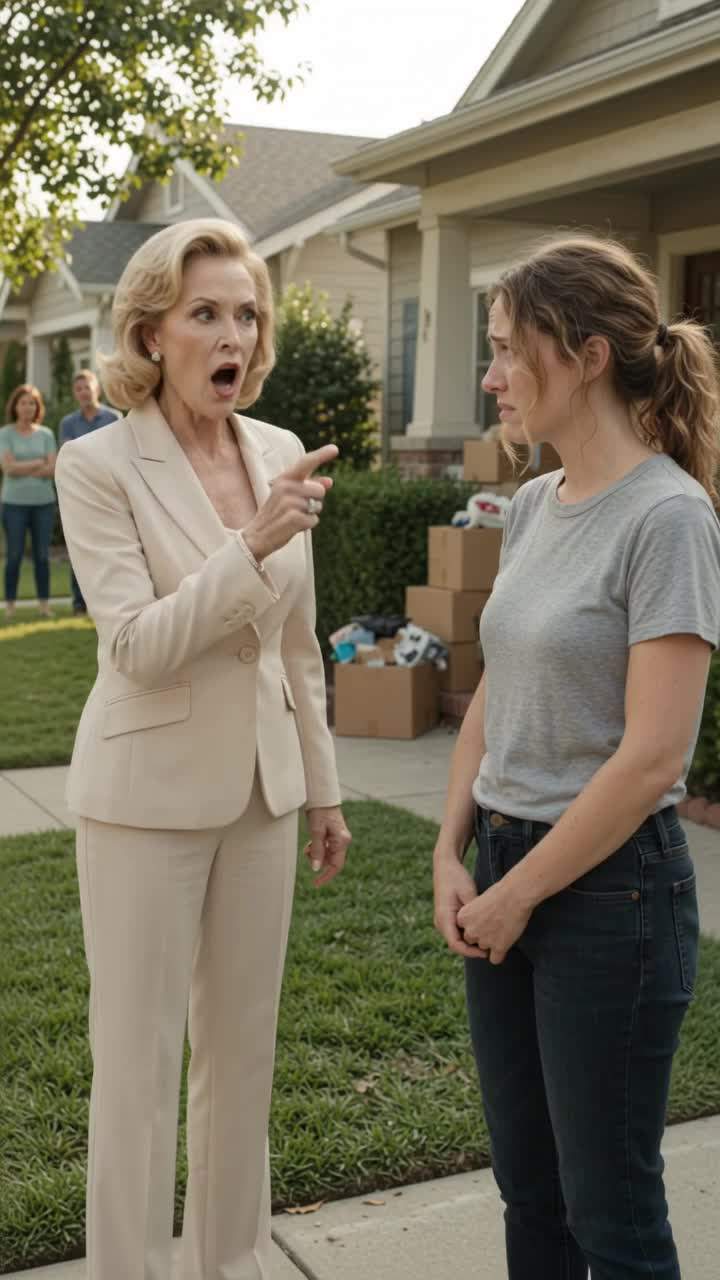
My shift at ‘FreshMarket’ usually started with a quiet dread, a familiar knot forming in my stomach that tightened whenever I thought about Sharon Dubois.
I’m Maria, twenty-six years old, and this grocery store isn't just a job; it’s my lifeline.
Every dollar I earned went towards supporting my younger sister, Sofia, who was struggling through her first year of college, and our aging mother, whose medical bills seemed to pile up faster than I could pay them.
I’d been working the checkout line for three years, a period long enough to understand the rhythm of customer service, but not long enough, it seemed, to escape the scorn of people like Sharon.
Sharon wasn't just any difficult customer; she was a Regional Operations Director for the colossal corporate entity that owned FreshMarket, and she used her title as a weapon.
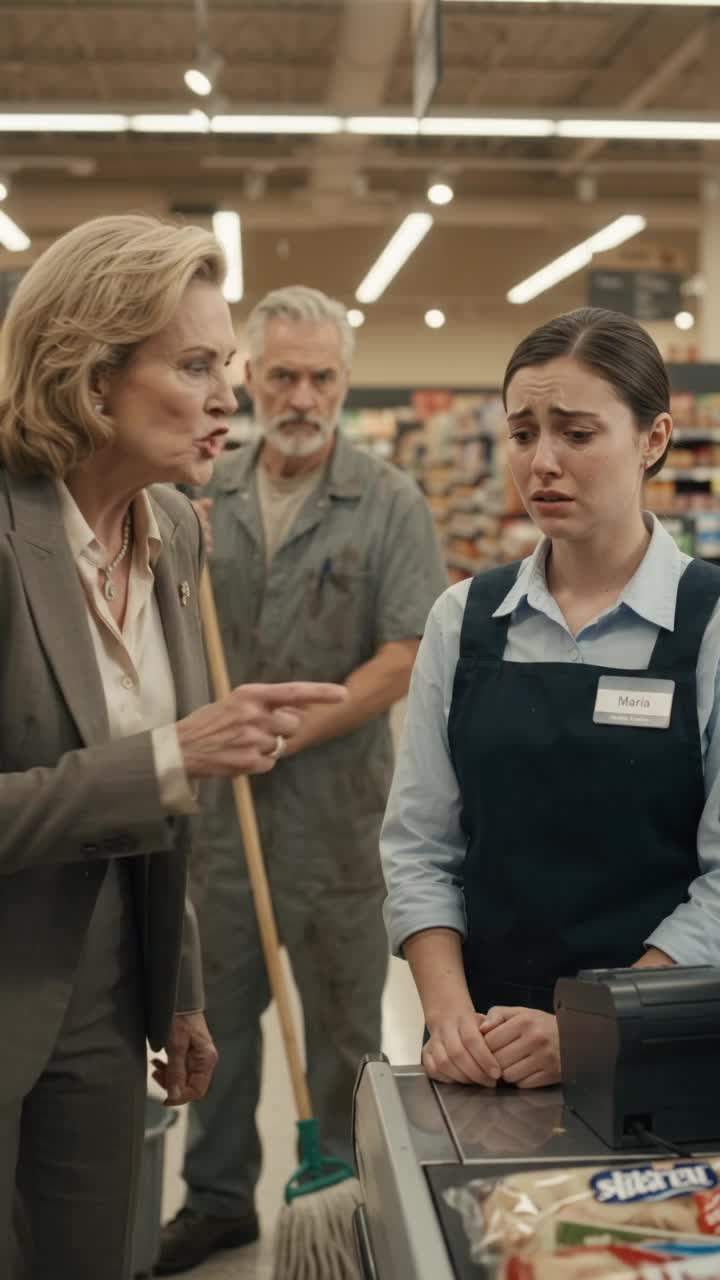
She’d frequently "visit" the store, not as a customer but as a self-appointed auditor of our misery, always finding fault, always leaving a trail of bruised egos and whispered complaints.
Her presence alone cast a dark cloud over the entire store, making even the most seasoned employees walk on eggshells.
Today, however, felt particularly cursed.
Sofia had called me that morning, in tears, about a sudden tuition increase she hadn't anticipated, pushing me to the brink of my emotional reserves.
I felt a cold panic grip me, wondering how I would bridge this new, impossible financial gap.
I was distracted, I admit, my mind replaying Sofia’s tearful voice, calculating numbers that never added up.
It was a small mistake, a mis-scan on a discounted organic kale, but to Sharon, it was a capital offense.
She was already fuming when she reached my register, her designer handbag clutched tightly, her eyes narrowed like a predator spotting weakness.
“Are you even paying attention, girl?” she snapped, her voice cutting through the cheerful store music.
My heart immediately sank, recognizing the venomous tone I had come to associate with her.
“I apologize, ma’am,” I started, my voice shaky despite my efforts to sound calm, “I seem to have made a mistake with the pricing. I’ll correct it right away.”
She slammed her hand on the conveyor belt, making the items jump, and several customers in line flinched.
“A mistake? This isn’t a mistake, it’s sheer incompetence!” she declared, loud enough for half the store to hear, her face growing red.
My cheeks burned with humiliation, but I forced myself to meet her furious gaze, remembering Sofia’s college dreams, my mother’s frail health.
“I’m really sorry, I’m just a bit preoccupied today,” I tried to explain, hoping for a sliver of human understanding, a rare commodity with Sharon.
But empathy was not in Sharon’s vocabulary, especially when she sensed vulnerability.
“Preoccupied? You’re paid to be here, to do your job properly, not to drift off into Lala Land!” she screeched, causing heads to turn.
I could feel tears pricking at my eyes, a dangerous sign that I was losing my composure.
“I’m fixing it now, ma’am,” I said, my voice barely a whisper, as I tried to override the price on the screen.
She leaned over the counter, invading my personal space, her breath hot and smelling faintly of expensive coffee and spite.
“Do you know who I am?” she hissed, her eyes blazing, “I’m Sharon Dubois. I know the district manager. I know people far higher up than that. I’ll have your job for this incompetence.”
The words struck me like a physical blow, sucking the air from my lungs.
My job.
The one thing standing between my family and utter financial ruin.
My hands trembled so violently I could barely hold the scanner, my eyes wide with fear and despair.
“Ma’am, please,” I pleaded, my voice cracking, “I truly need this job.”
“And I need competent staff,” she retorted, a cruel smirk twisting her lips, “which you clearly are not.”
In that moment, I wanted to disappear, to vanish from the harsh fluorescent lights, from the judging eyes of the other customers, from Sharon’s relentless cruelty.
I felt utterly helpless, a small cog in a giant machine, about to be crushed by someone who wielded power like a blunt instrument.
Just as Sharon was winding up for another verbal assault, I noticed a figure in my peripheral vision.
It was Arthur Thompson, our oldest cleaner, a quiet man in his sixties who usually kept to himself, moving through the aisles with a mop and bucket, always with a gentle, almost sad look in his eyes.
He had been mopping near Aisle 5, a steady, rhythmic swish, but now he had stopped, his mop leaning against a shelf, and he was watching us.
His expression, usually mild, was now unreadable, his gaze fixed intently on Sharon.
I dismissed him quickly; what could he do? He was just the cleaner, even lower on the corporate totem pole than me.
Sharon, seeing my fleeting glance towards Mr. Thompson, seemed to take it as a sign of disrespect, a challenge.
She straightened up, puffing out her chest, her voice rising to a triumphant crescendo.
“Your best isn’t good enough! I know the district manager. You’re fired!” she declared, making a dismissive wave of her hand as if swatting a fly.
The words hung in the air, a public execution of my livelihood.
My vision blurred, and a single tear escaped, tracing a hot path down my cheek.
A small part of me wanted to scream, to defend myself, but another, larger part was utterly broken, defeated.
Then, I heard a soft clatter.
Mr. Thompson had gently placed his mop and bucket against a display, the sound barely audible against Sharon’s retreating tirade.
He began to walk towards us, slowly, deliberately, his worn janitor’s jumpsuit a stark contrast to Sharon’s pristine business attire.
Sharon, caught up in her moment of victory, didn't even notice him until he was standing right beside her, his calm presence a stark contrast to her agitated energy.
He looked at her, then at me, his gaze lingering on my tear-streaked face for a fraction of a second before hardening slightly as he turned back to Sharon.
“Actually, Sharon,” he said, his voice surprisingly deep and firm, cutting through the tense silence, “that won’t be necessary.”
Sharon blinked, momentarily taken aback by the interruption from someone she clearly considered beneath her notice.
She scoffed, a dismissive sound, and turned to him fully, her expression radiating disdain.
“And who are you to say?” she demanded, her tone dripping with condescension, as if speaking to a child who had wandered into an adult conversation.
Mr. Thompson didn’t flinch.
He simply stood a little taller, a subtle shift in his posture, a quiet authority radiating from him that I had never noticed before.
His eyes, which I had always seen as kind and weary, now held a steely glint.
He met her gaze directly, his voice low but carrying an undeniable weight.
“I’m Arthur Thompson,” he stated, his name hanging in the air with a newfound gravitas.
He paused for a beat, letting the name sink in, though it meant nothing to me, or to Sharon, who just looked impatient.
Then, the words that followed shattered the oppressive atmosphere and redefined everything I thought I knew about my world.
“And as CEO of this entire corporate entity… you’re fired.”
The world stopped.
The cheerful store music seemed to screech to a halt in my mind.
Sharon’s face, moments ago contorted in fury, went slack.
Her jaw dropped, her eyes widened in complete disbelief, her perfectly made-up features crumbling into an expression of utter shock and dawning horror.
Her entire demeanor deflated, like a balloon suddenly punctured.
I gasped, a small, choked sound, covering my mouth with my hand, my own eyes wide with astonishment.
The old cleaner, Arthur Thompson, the CEO?
It was impossible, yet it was happening right before my eyes.
A ripple of murmurs spread through the gathered customers, who had been silently watching the scene unfold, now reacting with their own stunned gasps and whispers.
Sharon, finally regaining a sliver of her voice, stammered, “You… you can’t! I’m a Regional Director!”
Mr. Thompson, or rather, Mr. Arthur Thompson, CEO, merely raised an eyebrow, his expression unwavering.
“And you’ve just demonstrated why you are no longer fit for that role, or any role within my company,” he said, his voice quiet but absolute, “Your behavior towards employees and customers is unacceptable, unprofessional, and frankly, appalling. I’ve been observing you, Sharon, not just today, but for quite some time.”
He gestured vaguely with his hand towards the aisles, as if to say he’d been everywhere, seen everything.
“Consider this your immediate termination,” he concluded, his gaze firm, leaving no room for argument.
Sharon, pale and trembling, finally stumbled backwards, looking utterly defeated, her reign of terror brought to an abrupt and spectacular end.
She mumbled something incoherent, snatched her designer bag, and practically ran out of the store, a trail of humiliated silence in her wake.
The store manager, Mr. Henderson, who had scurried over during Mr. Thompson’s revelation, was now practically bowing, profusely apologizing and assuring the CEO of his dedication.
Mr. Thompson simply gave him a curt nod before turning his attention back to me.
He looked at me, his expression softening, a gentle smile replacing the sternness.
“Maria, are you alright?” he asked, his voice kind.
I was still in shock, my mind reeling, trying to process the extraordinary turn of events.
“Yes, Mr. Thompson,” I managed to stammer, my voice still trembling, but now with a mix of relief and sheer disbelief.
He nodded slowly.
“I apologize for the methods, but sometimes, to truly understand what goes on in our stores, one must see it through the eyes of those who keep it running,” he explained, a hint of weariness in his voice.
He went on to tell me that he frequently went undercover, sometimes as a cleaner, sometimes as a stock clerk, to observe the ground-level operations and, more importantly, the company culture and how employees were treated.
He had witnessed Sharon’s abusive behavior before, not just towards me, but towards others, and had been compiling a case against her.
Today’s incident, he said, was simply the final straw, a public display of the very toxicity he was determined to eradicate from his corporation.
“No employee should ever be subjected to such verbal abuse, especially from someone in a position of authority,” he stated, his eyes filled with a quiet resolve.
He then looked at me, a genuine warmth in his gaze.
“Maria, your professionalism, even under extreme pressure, did not go unnoticed. I’ve seen your work before. You handle difficult customers with grace, and you are dedicated.”
He then asked me about my aspirations, about Sofia, about my mother, listening patiently as I haltingly explained my situation.
By the end of our conversation, which felt like a blur, he had offered me a full scholarship for Sofia’s tuition and a promotion to a supervisory position within the store, along with a significant pay raise.
My head spun.
From the brink of despair, I had been lifted to a place of hope and opportunity I never dreamed possible.
The relief washed over me in powerful waves, leaving me light-headed and weak-kneed.
I could pay my mother’s bills.
Sofia could finish college without a mountain of debt.
My life, which had felt like a relentless uphill battle, suddenly had a clear, bright path forward.
That day, Arthur Thompson, the seemingly humble cleaner, didn't just fire a rude executive; he restored my faith in fairness and justice.
He taught me that true power isn't about titles or designer suits, but about integrity, empathy, and the courage to do what is right, even when it means getting your hands dirty, quite literally.
My shifts at FreshMarket no longer begin with dread, but with a renewed sense of purpose and gratitude.
The memory of Sharon’s shocked face, and Mr. Thompson’s quiet authority, serves as a powerful reminder that sometimes, the most unassuming figures hold the greatest power to change lives.