I remember the exact moment I decided to turn my small, unassuming house into a temporary hub for human kindness.
It wasn't a grand, spontaneous decision born of a sudden epiphany, but rather a slow, gnawing realization that our local homeless shelter was desperately under-resourced, especially as the colder months began to creep in.
I was Emily, a late-thirties single woman, working a steady but unexciting job, living in a quiet suburban neighborhood that prided itself on order and appearance.
My house, a modest two-bedroom bungalow, had always been perfectly adequate for my needs, never particularly flashy, but always neat.
That was, until the donations started pouring in.
It began with a few bags of clothes, then some canned goods, old blankets, and forgotten toys.
Word spread through my small social circle that I was collecting for the shelter, and soon, friends of friends, and even some generous strangers, were dropping off boxes and bags on my porch.
My living room, then the spare bedroom, and eventually even parts of the kitchen, transformed into a makeshift storage unit.
It was organized chaos, I told myself, a system only I could truly understand, a beautiful mess for a beautiful cause.
But to the outside world, particularly to my next-door neighbor, Patricia, it was just "mess."
Patricia lived in a house that seemed to have been plucked directly from the pages of a home decor magazine.
Her lawn was always impeccably manicured, her hydrangeas bloomed with aggressive perfection, and not a single leaf dared to linger on her pristine driveway.
She was the unofficial mayor of aesthetics on our block, her judging gaze a constant, unspoken commentary on anything that deviated from her exacting standards.
I’d first noticed her disapproving glances when the first few boxes started to accumulate on my porch, awaiting sorting.
A polite, yet frosty, "Morning, Emily, quite a collection you have there," would be delivered with a tight smile, her eyes lingering pointedly on a stack of donated sweaters.
I tried to explain, cheerfully at first, about the homeless drive, the urgent need, the good work we were doing.
Patricia would just nod, her lips pressed into a thin line, a look of profound discomfort clouding her otherwise serene face.
"Of course, dear," she’d murmur, her tone suggesting anything but understanding, "charity is wonderful, but one must maintain certain standards, mustn't one?"
Her passive-aggressiveness escalated subtly over the weeks.
I'd find anonymous notes tucked under my doormat, politely reminding me about neighborhood ordinances regarding "clutter."
My recycling bin, which admittedly often overflowed with cardboard from donation boxes, would mysteriously be "accidentally" knocked over on collection day, its contents strewn across my lawn for me to dutifully clean up.
I knew it was her, but I didn't have proof, and confronting her would only add fuel to her self-righteous fire.
My life became a blur of work, sorting, washing, packing, and making trips to the shelter whenever my car was full.
I’d come home exhausted, my own personal space shrinking under the weight of generosity, but my heart full of purpose.
My own needs, my house's appearance, my rest, all took a backseat.
I barely had time to do my own laundry, let alone maintain the picture-perfect facade Patricia expected.
The shame, initially a dull throb, began to grow.
I started avoiding eye contact with other neighbors, feeling their silent judgment, imagining their whispers.
Was I truly a messy, disorganized person, as Patricia implied?
Was my good deed overshadowing my responsibility to my home and neighborhood?
One sunny Tuesday afternoon, the tension finally boiled over.
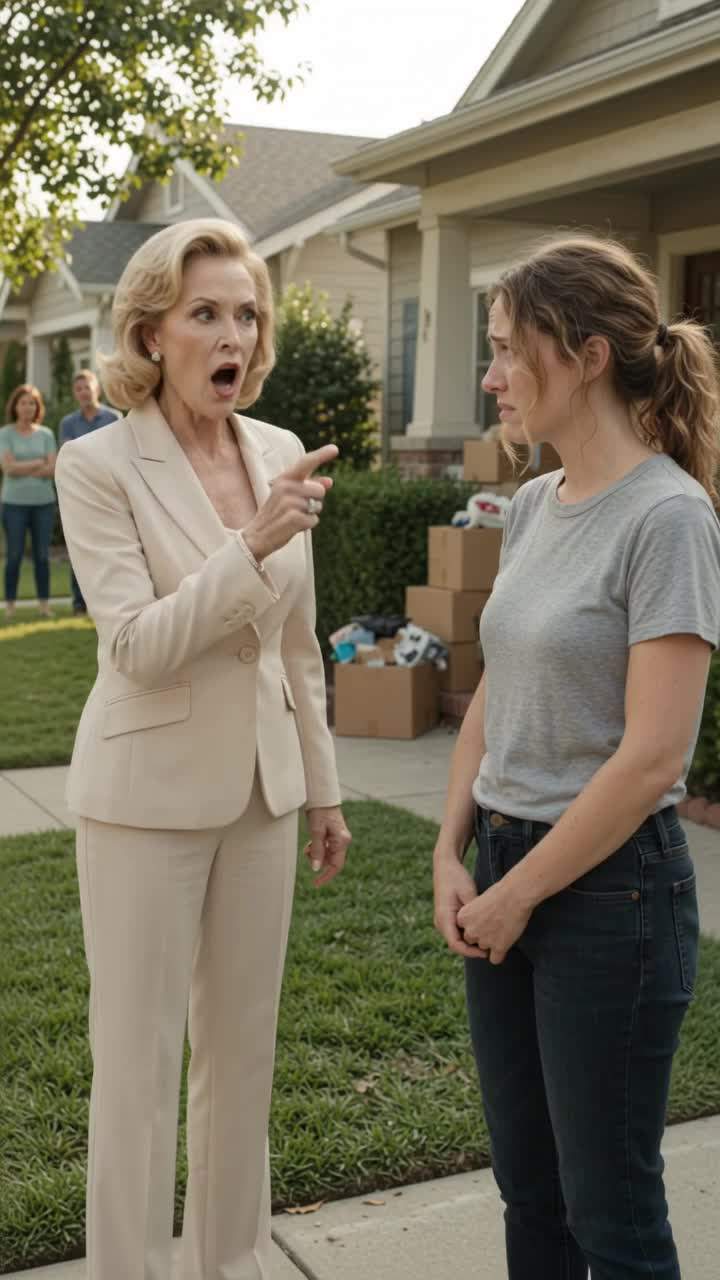
I was in my front yard, trying to sort through a pile of donated shoes, separating the wearable from the truly worn, when I heard Patricia’s voice, clear and sharp, cutting through the quiet hum of the afternoon.
She was standing at the edge of her perfectly manicured lawn, addressing a small group of neighbors who had gathered, ostensibly to chat, but whose eyes were all fixed on my increasingly chaotic property.
I instinctively hunched over the box of shoes, my cheeks burning.
"Honestly," Patricia declared, her voice carrying across the lawns, "it's become an absolute eyesore. And the smell! I don't know what she's hoarding in there, but it's attracting... goodness knows what."
My heart hammered against my ribs, a cold dread seeping through me.
I gripped the edge of the cardboard box, my knuckles white.
"It's not just the appearance, you know," she continued, her voice dripping with false concern, "it speaks to a certain... disregard. For oneself, for the community."
She paused, taking in my hunched form, her eyes gleaming with a triumph that made my stomach churn.
"It's frankly disgusting," she pronounced, her gaze sweeping over my house, then back to me, an accusation hanging heavy in the air.
A few neighbors shifted uncomfortably, avoiding my gaze, while others simply looked on, their faces unreadable.
I felt utterly exposed, mortified, a public spectacle of my perceived failings.
My throat tightened, and I could feel tears pricking at my eyes.
How could I explain, again, to these people who already seemed to have made up their minds?
What right did she have to speak about my character based on the state of my yard?
Just as I was about to stand up, to somehow defend myself, even though I knew my voice would probably crack, a low rumble started in the distance.
It grew steadily louder, a deep, mechanical thrum that drew everyone’s attention.
A large, white delivery truck, emblazoned with the unmistakable logo of "Community Outreach Services," slowly turned the corner and pulled up directly in front of my house.
It was Dave, the driver from the shelter, a kind-faced man in his forties with a perpetually cheerful demeanor.
He hopped out of the cab, a wide smile spreading across his face as he spotted me.
"Morning, Emily!" he called out, his voice booming with genuine warmth, "Got your delivery! The shelter was practically empty, we couldn't have managed without you!"
He walked around to the back of the truck, unlatched the large roll-up door, and with a soft whoosh, slid it open.
Inside, neatly stacked and meticulously organized, were dozens of boxes and industrial-sized bags, all clearly labeled: "Clothing," "Non-Perishable Food," "Toiletries," "Blankets."
It was a veritable mountain of compassion, waiting to be unloaded.
Dave gestured proudly at the contents.
"Plenty of good stuff here for the shelter," he declared, his voice easily audible to Patricia and the now-silent group of neighbors.
Patricia’s face, which moments before had been contorted in self-righteous indignation, now slackened.
Her jaw dropped, her eyes wide with a mixture of shock and dawning horror.
The other neighbors, who had been listening to her pronouncements with varying degrees of agreement, now exchanged glances, a ripple of understanding, then embarrassment, passing through them.
I slowly stood up, brushing dust from my clothes, my gaze meeting Patricia’s.
The tears that had threatened earlier were gone, replaced by a quiet, fierce sense of vindication.
I didn't need to say anything; the truth, a massive, tangible truth, was right there for everyone to see.
"It's all for the homeless shelter, Patricia," I said, my voice calm, steady, and clear, completely devoid of the tremor it had held moments before.
The words hung in the air, a stark contrast to her earlier accusation of "disgusting."
Patricia stammered, her cheeks flushing a deep crimson.
She tried to form words, but nothing coherent emerged, only a pathetic gasp.
She glanced at the other neighbors, whose expressions had shifted from judgment to a quiet, uncomfortable understanding, some even offering me small, apologetic smiles.
Without another word, Patricia turned abruptly and practically scurried back into her pristine house, the door clicking shut behind her with a definitive thud.
Dave, oblivious to the drama he had unwittingly diffused, started efficiently unloading the first few boxes.
Slowly, hesitantly, the neighbors began to approach.
"Emily, I... I had no idea," one woman, Mrs. Henderson, stammered, her face etched with genuine remorse.
"Can we help you unload these?" another offered, already reaching for a box.
In the days that followed, my house transformed again, but this time, it was different.
The mess didn't disappear overnight, but the understanding did.
Neighbors who had once given me frosty looks now stopped to chat, offering words of encouragement, or even bringing their own donations.
A few even volunteered to help me sort and transport items, turning my "disgusting" clutter into a shared community project.
Patricia, for her part, remained largely confined to her house, her perfectly manicured lawn now seeming less like a triumph and more like a barrier.
Our neighborhood, once defined by its quiet uniformity, had experienced a small, profound shift.
I learned that day that appearances can be deceiving, and sometimes, the biggest messes hide the biggest hearts.
And I also learned that truth, when it arrives in the form of a fully loaded charity truck, can be the most beautiful and eloquent defense of all.