Graduation day was supposed to be my triumph, a gateway to a future I’d painstakingly carved out of whispers and stolen moments.
My name is Sarah, and for eighteen years, my life had been a meticulously painted canvas, but not by my hand.
My mother, Eleanor, was the artist of my destiny, each brushstroke a command, each color a preference that was never truly mine.
She envisioned me as a brilliant corporate lawyer, a successful doctor, anything that promised prestige and a fat bank account.
Art, my solace, my passion, was merely a frivolous hobby in her eyes, a distraction from the “real” work of shaping my future.
From a young age, I was enrolled in advanced science classes, debate clubs, and pre-law summer camps, while my sketchbooks were hidden under my bed, my paint-stained clothes quickly scrubbed clean before she could see them.
Every time I tried to voice my dreams, she’d dismiss them with a wave of her hand, a tight smile, and a reminder of all the sacrifices she’d made for me.
“Sarah, darling, I only want what’s best for you,” she’d say, her voice a velvet trap.
Her definition of “best” was always rooted in her own unfulfilled aspirations, a life of stability and status she believed I deserved, even if it wasn't the one I craved.
My father, bless his quiet heart, was often a bystander in these battles, his occasional attempts to mediate quickly squashed by Eleanor’s dominant will.
He loved me, I knew, but he had long since learned that peace in our home meant not challenging Eleanor’s grand designs.
The turning point came when I secretly applied to the prestigious Rhode Island School of Design, pouring my soul into a portfolio I created in the dead of night.
I didn’t dare tell my mother.
The acceptance letter felt like a lifeline thrown into a raging sea, a glimmer of hope I clutched with both hands.
Along with the acceptance, RISD offered me a substantial art scholarship, enough to make my dream feel tangible, a possibility even without my mother’s financial blessing.
But how to tell her?
The thought alone tied my stomach in knots.
I decided to wait, to let the weight of the scholarship make my case for me, hoping the undeniable achievement would soften her stance.
The week before graduation, Eleanor presented me with a gift, a small, exquisitely crafted ceramic sculpture of a bird.
It was beautiful, undeniably, but it was also a symbol of her control, a delicate cage meant to represent her idea of perfection.
She always adored these ornate, classical pieces, while my own art leaned towards abstract, raw, and often messy expressions of emotion.
“This, Sarah, is true art,” she’d declared, her fingers tracing the intricate feathers.
“Something timeless, something refined, unlike some of the… experiments you dabble in.”
Her words stung, a subtle invalidation of everything I held dear.
I smiled, thanked her, and carefully placed the bird on my dresser, feeling its fragile beauty as a constant reminder of the chasm between us.
Graduation day arrived, a blur of caps and gowns, proud parents, and hopeful young faces.
My heart pounded with a mix of excitement and dread.
The art scholarship was scheduled to be announced towards the end of the ceremony, and I knew that would be my moment of truth.
I watched as my classmates crossed the stage, received their diplomas, and shook the principal’s hand, a knot tightening in my chest with each passing name.
Finally, Principal Harrison stepped up to the podium, his voice booming through the auditorium.
“And now, for a special announcement,” he began, “the recipient of this year’s prestigious St. Jude Art Scholarship, recognizing exceptional talent and promise…”
He paused, a dramatic flair for the occasion.
“Please join me in congratulating Sarah Miller!”
A wave of applause erupted, and I felt a surge of elation, a momentary lightness as I rose and began walking towards the stage.
This was it, my validation, my escape.
As I ascended the steps, my eyes scanned the crowd, searching for my mother.
I saw her, standing abruptly in her seat, her face pale, her eyes wide with a mixture of shock and disbelief.
Then, she moved.
She began to push through the rows of seated parents, her elegant dress rustling, her composure crumbling with every frantic step.
A ripple of confused murmurs spread through the audience.
My heart sank, a cold dread washing over me.
She was coming for me.
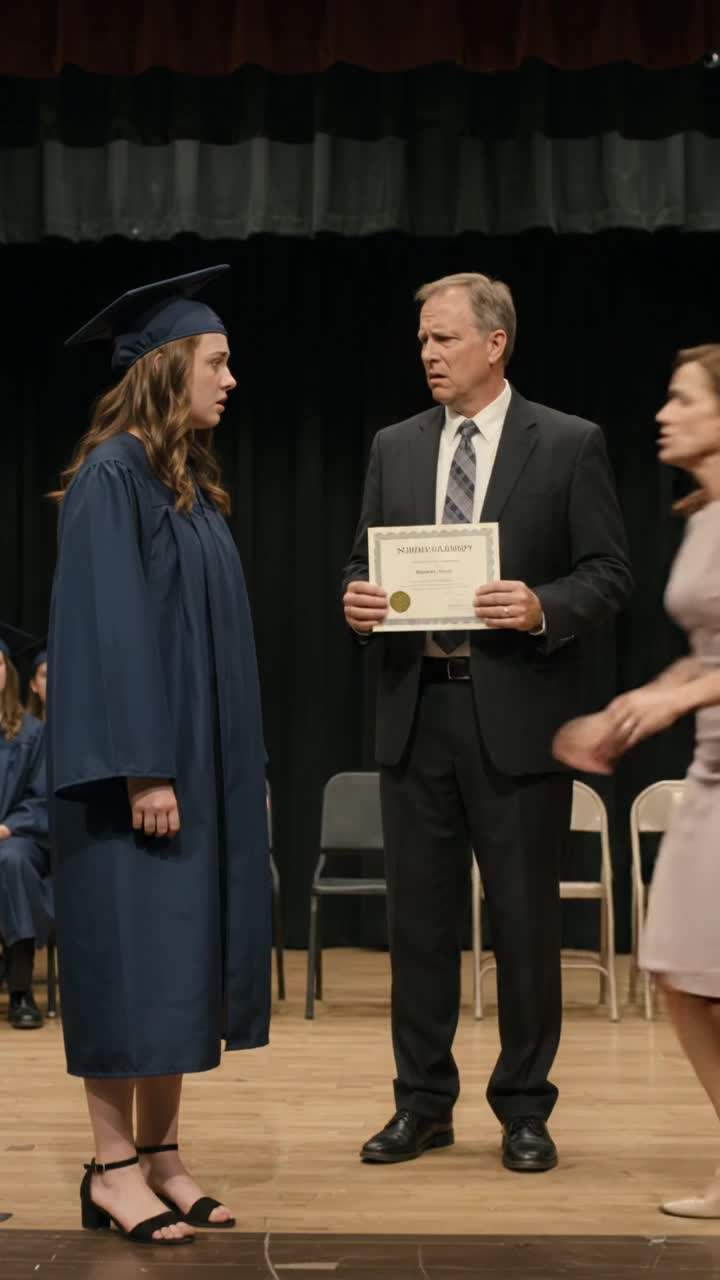
I reached Principal Harrison, a forced smile on my face, even as my peripheral vision registered my mother’s hurried approach.
He extended the large, ceremonial scholarship certificate towards me, a proud smile on his face.
Just as my fingers brushed the parchment, a hand clamped down on my arm, firm and unyielding.
It was Eleanor.
Her grip was tight, almost painful, and her eyes, usually so composed, were wild with a desperate panic.
“No, Sarah!” she cried out, her voice sharp and raw, cutting through the polite applause and general hum of the auditorium.
“You can’t take this! Please, darling, think about your future!”
Her words echoed through the stunned silence that followed, humiliating me beyond anything I had ever experienced.
My cheeks burned, and I felt the weight of hundreds of eyes on me, judging, pitying, curious.
Principal Harrison looked utterly bewildered, the scholarship certificate still extended awkwardly in his hand.
I pulled my arm away from her grasp, my voice a strangled whisper, laced with incredulity and simmering rage.
“Mom, what are you doing?” I asked, my voice barely audible, but vibrating with years of suppressed anger.
My mother, oblivious to the public spectacle she was creating, tightened her grip on my other arm, her nails digging into my skin.
She tried to physically pull me away from the principal, away from the scholarship, away from my dream.
“This is not you, Sarah!” she pleaded, her voice cracking, tears welling in her eyes.
“You’re meant for something greater, something real!”
In that moment, standing on that stage, exposed and humiliated, something inside me snapped.
All the years of her control, her dismissal of my passion, her relentless push towards a life I didn’t want, converged into a single, explosive point.
I looked at her, truly looked at her, and saw not love, but a suffocating fear, a need to control that was destroying me.
I ripped my arm free from her grasp, a sudden, powerful defiance coursing through my veins.
My voice, usually soft and pliable around her, rose with an unfamiliar strength.
“I’m doing what I want for once!” I declared, the words ringing out across the stunned silence of the auditorium.
The ceramic bird, her “gift,” was still clutched in my hand, a cold, hard symbol of her suffocating expectations.
It had been in my pocket, a strange comfort, a physical representation of the choice I was about to make.
Without another thought, fueled by a searing mixture of pain, rage, and a desperate need for freedom, I lifted my hand.
My eyes locked with hers, a silent, defiant challenge passing between us.
Then, with a force that surprised even myself, I hurled the delicate ceramic bird onto the polished wooden stage.
It hit with a sickening crunch, shattering into a hundred sharp, glittering pieces that scattered across the floor like broken dreams.
A collective gasp swept through the audience.
My mother flinched, her face a mask of shock and heartbreak, her perfectly coiffed hair slightly disheveled.
The shattered remains of her "art" lay between us, a stark, undeniable testament to my rebellion.
I stood there, breathing heavily, tears stinging my eyes, but refusing to let them fall.
My chest heaved, a strange mix of terror and exhilarating liberation washing over me.
Principal Harrison, still holding the scholarship certificate, stammered a weak attempt to restore order, but the moment had already been irrevocably broken.
The audience, a sea of hushed whispers and astonished faces, watched us, two figures frozen in a tableau of shattered expectations.
I didn't care about the scholarship anymore, not in that instant.
All I cared about was finally being seen, finally being heard, finally being free.
I turned, leaving my mother standing amidst the broken shards, and walked off the stage, my graduation gown feeling like a shroud, heavy with the weight of my past.
The days that followed were a whirlwind of arguments, accusations, and icy silence.
My mother was devastated, her pride wounded, her vision for my future violently disrupted.
She couldn’t comprehend my actions, seeing them as a brutal rejection of her love, a public shaming she would never forget.
My father, for the first time in years, stood up to her, albeit gently, urging her to listen to me, to understand my pain.
It was a small victory, but a victory nonetheless.
I didn’t attend the graduation party she had meticulously planned.
Instead, I spent those days packing, making arrangements, and preparing to leave for RISD, with or without her blessing.
The scholarship, thankfully, remained mine.
The dean of admissions had called, expressing concern but ultimately respecting my choice, acknowledging the fire he saw in my art.
Leaving home was harder than I imagined, filled with guilt and a profound sadness for the mother-daughter relationship that felt irreparably broken.
But as I drove away, my old beat-up car laden with my art supplies and a fragile sense of hope, I also felt an immense lightness, a freedom I had never known.
I still paint, now in a studio of my own, the canvas a boundless space for my raw emotions and unbridled imagination.
Sometimes, I trace the scars on my arm where my mother’s nails dug in, a physical reminder of that day, that breaking point.
I know the path I chose is uncertain, filled with challenges and doubts, but it is my path.
The ceramic bird, though shattered, taught me a crucial lesson: sometimes, to truly live, you have to break free from the cages others build for you, no matter how beautifully crafted they may be.
My mother and I rarely speak now, our conversations strained and brief, but sometimes, late at night, I wonder if she ever truly understood.
I hope, one day, she will see that the greatest art I could ever create was the life I chose for myself.