The air in the gallery was thick with anticipation, a nervous energy that vibrated through the hushed crowd.
My heart hammered against my ribs, mirroring Elara’s frantic beat beside me.
This was her night, the culmination of years of tireless work, endless sketches, and the kind of fierce dedication only a true artist understands.
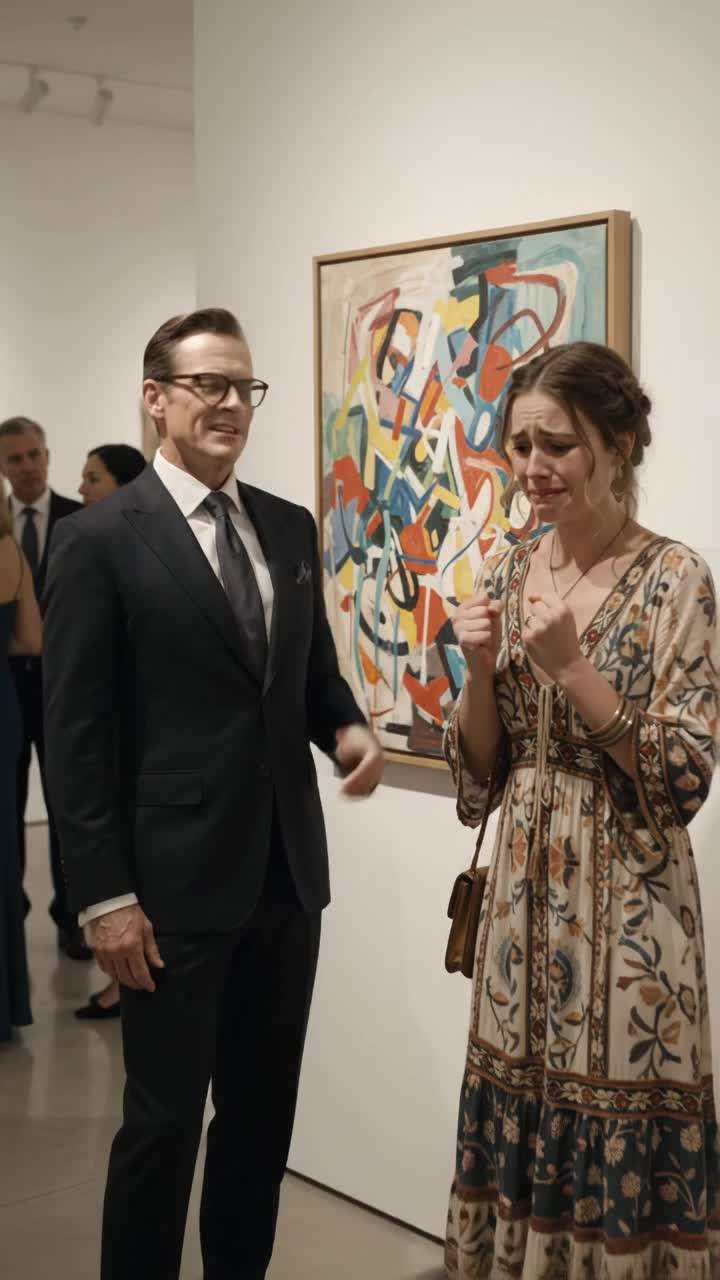
Elara, my best friend since art school, stood small and vulnerable next to her masterpiece, a vibrant abstract painting that pulsed with raw emotion and audacious color.
I had seen her pour every ounce of her soul into that canvas.
It was her first solo exhibition, a dream she’d chased with an almost desperate intensity, and I was there to witness her triumph or, as I secretly feared, her crucifixion.
The source of that fear had just swept into the room, a looming shadow in an impeccably tailored suit: Arthur Penhaligon.
He wasn’t just an art critic; he was the art critic, a man whose pronouncements could elevate or annihilate careers with a single, cutting phrase.
His reputation preceded him like a dark cloud, a legend of brutal honesty and intellectual arrogance.
I had seen other artists wither under his gaze, their confidence crumbling like fragile pottery.
Elara knew the risks, but she believed her art spoke for itself.
Still, her hands were clammy, and her smile, usually so radiant, was fragile, almost transparent.
Arthur moved through the gallery like a predator, his eyes darting from canvas to canvas, his lips curled in a perpetual sneer of mild disapproval.
Each of his mumbled comments, even when unheard, seemed to drain the color from the vibrant space.
The room held its breath as he approached Elara’s painting, the largest and boldest piece in the collection.
He paused, a theatrical silence descending upon the onlookers, myself included.
My stomach twisted into knots.
He circled the painting slowly, his head cocked, his expression unreadable, then, with a dismissive flick of his wrist, he began his dissection.
“This ‘piece’,” he announced, his voice carrying an almost theatrical disdain, “lacks any semblance of historical context or artistic foundation. A mere splash of color, devoid of soul, a childish outburst on canvas.”
His gaze, cold and condescending, flickered to Elara, who stood frozen, her eyes welling up with unshed tears.
My blood ran cold.
He continued, seemingly fueled by her visible distress, expanding on his critique with an air of unassailable authority.
“One must understand the roots of true artistic expression,” he declared, turning to address the captivated, if uncomfortable, audience.
“As I meticulously detailed in my acclaimed ‘Art and Epochs’ – a text widely considered seminal, mind you – great works are built upon tradition and meticulous study.”
He paused for dramatic effect, then delivered what he clearly believed was a crushing blow.
“Take Van Gogh, for instance. His iconic ‘Starry Night’ was born from the desolate winter skies above Saint-Paul. A stark, cold inspiration, reflecting his profound torment. This artist,” he gestured vaguely at Elara’s painting with a patronizing sweep of his hand, “clearly missed that fundamental lesson in understanding artistic genesis.”
A collective murmur rippled through the crowd, a mix of agreement, discomfort, and perhaps, a touch of pity for Elara.
Her shoulders slumped, her spirit visibly crushed.
I felt a surge of protectiveness, a desperate urge to shield her from his cruel words, but I knew my voice wouldn’t carry the weight needed to challenge him.
It was over.
Her dream, her exhibition, seemed to shatter into a million tiny pieces around her.
Then, through the hushed tension, a soft, familiar squeak broke the silence.
George Miller, the gallery’s long-standing janitor, was pushing his cleaning cart slowly through a side aisle.
He was a quiet, unassuming man, always in the background, a part of the scenery.
I had often exchanged pleasantries with him, noting his kind eyes and gentle smile, but never imagined him as anything more than a diligent worker.
He stopped his cart directly behind Arthur, the faint smell of lemon polish briefly cutting through the expensive perfumes.
George slowly put down his mop, his movements deliberate, his gaze calm.
He looked directly at Arthur, then, surprisingly, at Elara, offering her a faint, almost imperceptible nod.
My breath hitched.
“Excuse me, sir,” George’s voice, though soft, cut through the residual tension like a finely honed blade.
Arthur, momentarily surprised by the interruption from such an unexpected source, turned to face him, his face a mask of patronizing irritation.
“With all due respect, Mr. Penhaligon,” George continued, his tone unwavering, “’The Starry Night’ was painted in June of 1889. From his east-facing window at the asylum in Saint-Rémy, to be precise.”
A collective gasp, louder this time, swept through the gallery.
Arthur’s haughty smirk dissolved instantly, replaced by a look of sheer bewilderment.
His eyes, which had moments ago gleamed with superior knowledge, widened in disbelief.
George, ever so calm, wasn't finished.
“The ‘winter sky’ theory was indeed popular for a time,” he explained, almost conversationally, “but it was definitively discredited by art historians in the early 1990s, when his letters and hospital records were more thoroughly analyzed.”
He then, with a subtle, almost imperceptible gesture, pointed his cleaning cloth directly towards Arthur’s chest.
“Your highly acclaimed book, ‘Art and Epochs,’ was, if I recall correctly, published in 1988.”
The silence that followed was deafening, thicker than any tension before.
Arthur stood utterly stunned, his mouth agape, his carefully constructed facade of infallibility crumbling to dust around him.
His eyes darted around the room, desperately seeking an escape, a rebuttal, anything to salvage his rapidly evaporating credibility.
Elara’s head snapped up, her eyes, previously filled with despair, now sparkled with a mix of shock, confusion, and then, a fierce, defiant hope.
A tiny, triumphant smile began to form on her lips.
“He’s right,” she whispered, barely audible, but her voice held a new strength, a burgeoning belief in herself.
The audience, initially stunned, erupted in a cacophony of murmurs, some stifled laughs, others outright gasps of disbelief and dawning realization.
Arthur, humiliated, mumbled something incoherent and, looking utterly defeated, practically scurried away into the crowd.
George simply gave Elara another small, knowing smile, picked up his mop, and continued pushing his cart, as if nothing out of the ordinary had happened.
My jaw was on the floor, and a thrill, a pure, unadulterated sense of satisfaction, surged through me.
I rushed to Elara, hugging her tight, tears of relief now mixing with her earlier despair.
The remaining hours of the exhibition were transformed.
Attendees revisited Elara’s painting with fresh eyes, no longer swayed by the critic’s venom.
They saw the passion, the technique, the unique vision that Arthur had tried to obscure.
News of the incident spread like wildfire through the art world.
Within days, George Miller, the unassuming janitor, became an unlikely legend.
We later learned that George wasn’t just a janitor.
He had been a brilliant art history professor years ago, at a prestigious university, but had left academia after a personal tragedy, seeking a simpler life away from the cutthroat intellectual battles.
He had found peace in the quiet service of art, still observing, still learning, but from a different vantage point.
His intervention wasn't about seeking glory; it was simply about truth.
Arthur Penhaligon’s career, while not entirely over, was forever tainted.
His pronouncements now carried the weight of a punchline, his authority questioned, his arrogance exposed.
Elara’s exhibition, initially a potential disaster, became a sensation, drawing crowds and critical acclaim from real critics.
Her art was bought, her name made, not just because of the drama, but because her work was genuinely powerful, and now, people could see it without the filter of prejudice.
She received commissions, opportunities she could only have dreamed of.
We sought out George a few days later, bringing him flowers and a heartfelt thank you.
He just smiled, his kind eyes twinkling.
“Art,” he said, in his soft, measured voice, “should speak for itself. Critics are just mirrors, and sometimes, those mirrors need a good cleaning.”
His words, simple yet profound, resonated deeply with us.
I looked at Elara, her face radiating a newfound confidence and clarity.
Her dream hadn't died that night; it had been reborn, stronger and more resilient, all thanks to a quiet man with a mop and an encyclopedic knowledge of art history.
It was a powerful reminder that wisdom and integrity can emerge from the most unexpected places, often when we need it most.
And sometimes, the most influential voice in a room isn't the loudest, but the one that speaks the truth, calmly and unequivocally.