You wouldn't believe what happened at dinner the other night.
I still can’t quite wrap my head around it.
Life for us, for Ethan and me, had been one long, flat line for three years.
It started the day Claire, my wife, was gone.
And Ethan…
His world narrowed to ramps and wheels and endless hospital rooms.
He was ten.
A car crash took away his mom and his legs in one brutal moment.
The doctors, they were kind, but firm.
Spinal damage.
Permanent.
He wouldn't walk again.
Ever.
Every specialist, every experimental treatment, every single sliver of hope dangled in front of me had been snatched away.
It left me hollowed out.
Cynical.
I tried to hide it from Ethan.
I put on a brave face.
I pushed him through physical therapy, through school, through life.
But inside, I was just going through the motions.
He was too.
My spirited, loud son had become quiet.
Too quiet.
So, when this little girl appeared beside our table, it felt like another bad joke from the universe.
We were just trying to get through dinner.
She was small.
Maybe eleven years old, tops.
Her cotton dress was faded to almost no color at all.
Her hands were marked with dirt, but her dark hair was carefully pulled back in a neat braid.
She didn’t look bold.
She didn’t look desperate.
She just looked… calm.
She stood there for a beat.
Then she spoke.
Her voice was soft, but it carried.
“Give me something to eat,” she said, looking right at me.
“And I’ll help your son.”
I literally stopped chewing.
My fork clattered softly onto my plate.
I looked up, certain I’d misheard her.
Help Ethan?
This child?
Ethan sat across from me, his ten-year-old body quiet in his wheelchair.
His legs rested motionless beneath his jeans.
Thin and lifeless.
I couldn’t help it.
A dry, tired chuckle escaped me.
It wasn't amusement.
It was pure, bitter exhaustion.
“You think you can fix him?” I asked, the words heavy with disbelief.
“You’re just a kid.”
Her eyes, dark and steady, never left mine.
“I don’t want money,” she replied, her voice completely even.
No waver.
No plea.
“Just a meal. One. Then I’ll do what my grandmother taught me.”
My head started to throb.
The last three years flashed through my mind.
The promises.
The dashed hopes.
The crushing weight of reality.
How many times had someone tried to sell me some miracle?
Some new therapy?
Some impossible cure?
“Dad,” Ethan’s voice was barely a whisper across the table.
It startled me.
He was usually so quiet, so accepting of his fate.
“Please. Let her.”
My heart ached at the quiet desperation in his voice.
He almost never asked for anything anymore.
He almost never hoped.
I hesitated.
I searched the girl’s face.
For deceit.
For desperation.
For anything that would make sense of this.
I found neither.
Just that unsettling calm.
Against every instinct I had, against every rational thought, I signaled the waiter.
The girl gave a faint smile.
It was almost imperceptible.
“My name’s Lila,” she said.
When the food arrived, she ate quickly.
Without a sound.
As if each bite was a precious gift.
I watched her.
She didn’t gorge herself, but she clearly ate with purpose.
Near the end, she slowed.
Savoring the warmth of the food, more than just the taste itself.
When she finished, she wiped her hands on her dress, almost primly.
Then she looked up at me again.
“Could we go somewhere a little quieter?” she asked, her voice still soft.
“I’ll show you.”
Every alarm bell in my head was screaming.
This was insane.
What was I doing?
But Ethan’s eyes.
That tiny spark.
I couldn’t deny him that flicker of hope, no matter how irrational.
I pushed his wheelchair outside.
To the small, dimly lit park behind the restaurant.
The evening air was cool.
A soft breeze rustled the leaves in the trees.
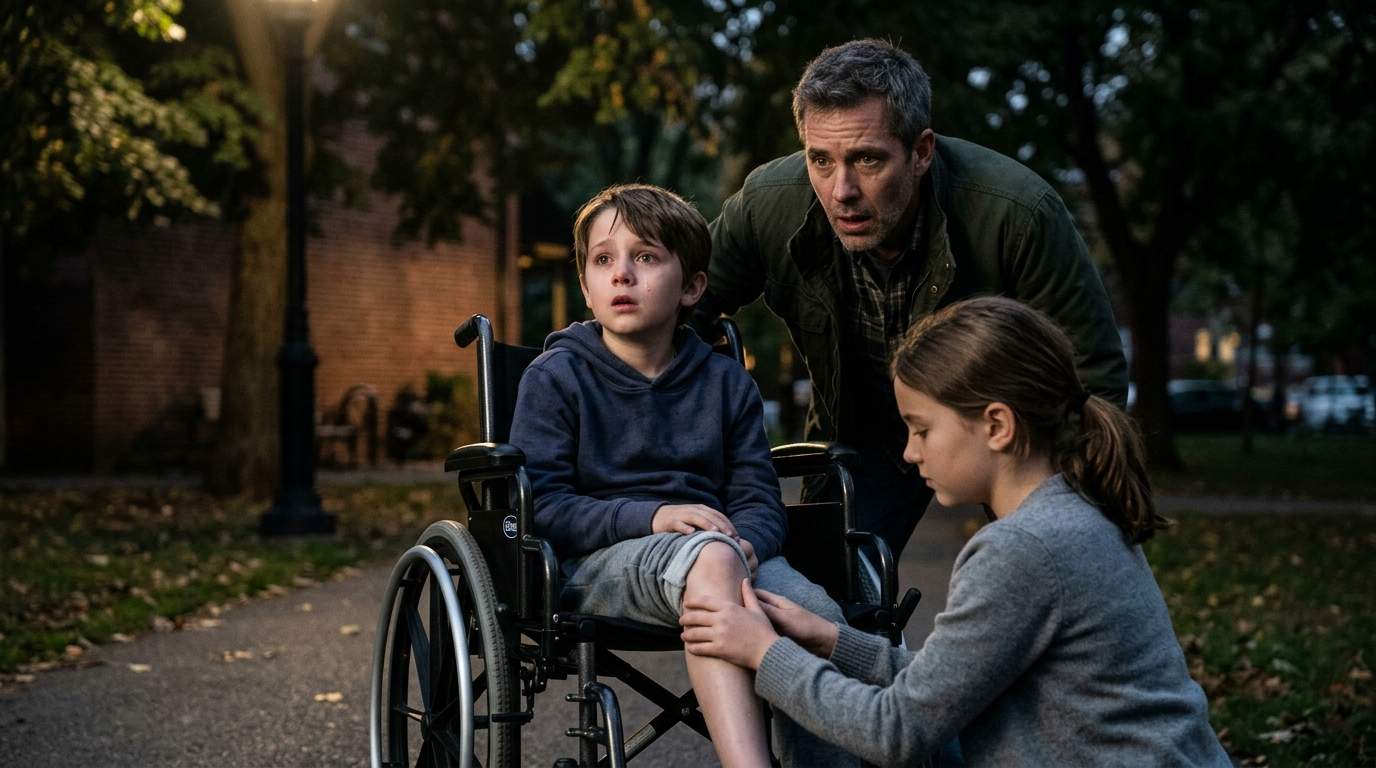
Lila knelt in front of Ethan.
She gently, carefully, rolled up one of his pant legs.
Her hands, small but purposeful, began to move.
Pressing here.
Stretching there.
Pausing.
Then continuing again.
Firm.
But so careful.
I felt a surge of protectiveness, of anger at myself for letting this go on.
“This is ridiculous,” I muttered, my voice tight.
But then Ethan’s eyes widened.
His breath hitched.
He gasped.
He was staring at his leg.
At Lila’s hands.
“Dad…” he whispered, his voice trembling with something I couldn’t quite place.
“It feels… different. Weird. But good.”
My breath caught in my throat.
My heart slammed against my ribs.
It had been three years.
Three years since he’d felt anything in those legs.
Three years since any sensation other than numbness or phantom pain.
Lila just kept working, her face intent.
She finished with one leg.
Then she looked up at me, a tiny bead of sweat on her forehead.
“Your grandmother teaches you this?” I managed to ask, my voice hoarse.
She just nodded, a small, knowing smile.
“It’s old ways,” she said, her voice barely audible.
“From my people. To bring feeling back. To wake up what sleeps.”
She moved to the other leg.
Ethan was just staring down, tears welling in his eyes.
Not tears of pain.
Tears of pure, bewildered wonder.
I stood there, watching this child.
This stranger.
Bringing back feeling to my son's legs.
The doctors said it was impossible.
Permanent damage.
But now…
Ethan was making small, almost imperceptible movements with his toes.
His toes.
It couldn’t be.
Could it?
Lila finished the second leg.
She stood up.
Wiped her hands on her dress again.
“He’ll be sore tomorrow,” she said simply.
“Like he ran a long race. But the feeling… it is back. He needs to move them now. Every day.”
Then she turned.
And walked away, disappearing into the dimness of the park, leaving us alone in the cool evening air.
Just me, Ethan, and the impossible flutter of hope…
And a thousand questions with no answers.