Stepping off that plane felt unreal.
The air, even the airport air, smelled different.
Not like sand and dust.
Not like fear.
Just… home.
It had been exactly 367 days since I last saw American soil.
367 days since I hugged my little girl.
Sarah.
Her laugh was the soundtrack in my head through every long patrol.
Her crayon drawings were folded in my helmet.
I counted the hours.
The minutes.
I’d pictured this moment a thousand times.
Her running into my arms.
Her smile.
The surprise in her eyes.
I grabbed my duffel, pushed through the crowds.
Didn't even stop to change out of my uniform.
Just wanted to get to her school before dismissal.
I drove like a man possessed.
The familiar streets were a blur.
The old oak trees.
The faded brick of the elementary school.
It all felt exactly the same.
But I was different.
I pulled into the parking lot.
Kids were everywhere.
A noisy, joyful chaos.
Parents clustered, chatting, laughing.
A scene of perfect, ordinary life.
The kind of life I’d been fighting to protect.
I slung my bag over my shoulder, took a deep breath.
A mix of nerves and pure elation.
This was it.
I stepped onto the playground, my boots heavy on the wood chips.
Searched for her bright red backpack.
Then I saw her.
By the old swing set.
Not running.
Not playing.
Sarah was standing alone.
Her back to me.
Her small shoulders shaking.
My heart seized up.
It wasn't a playful shake.
It was a crying shake.
A deep, heartbroken kind of shake.
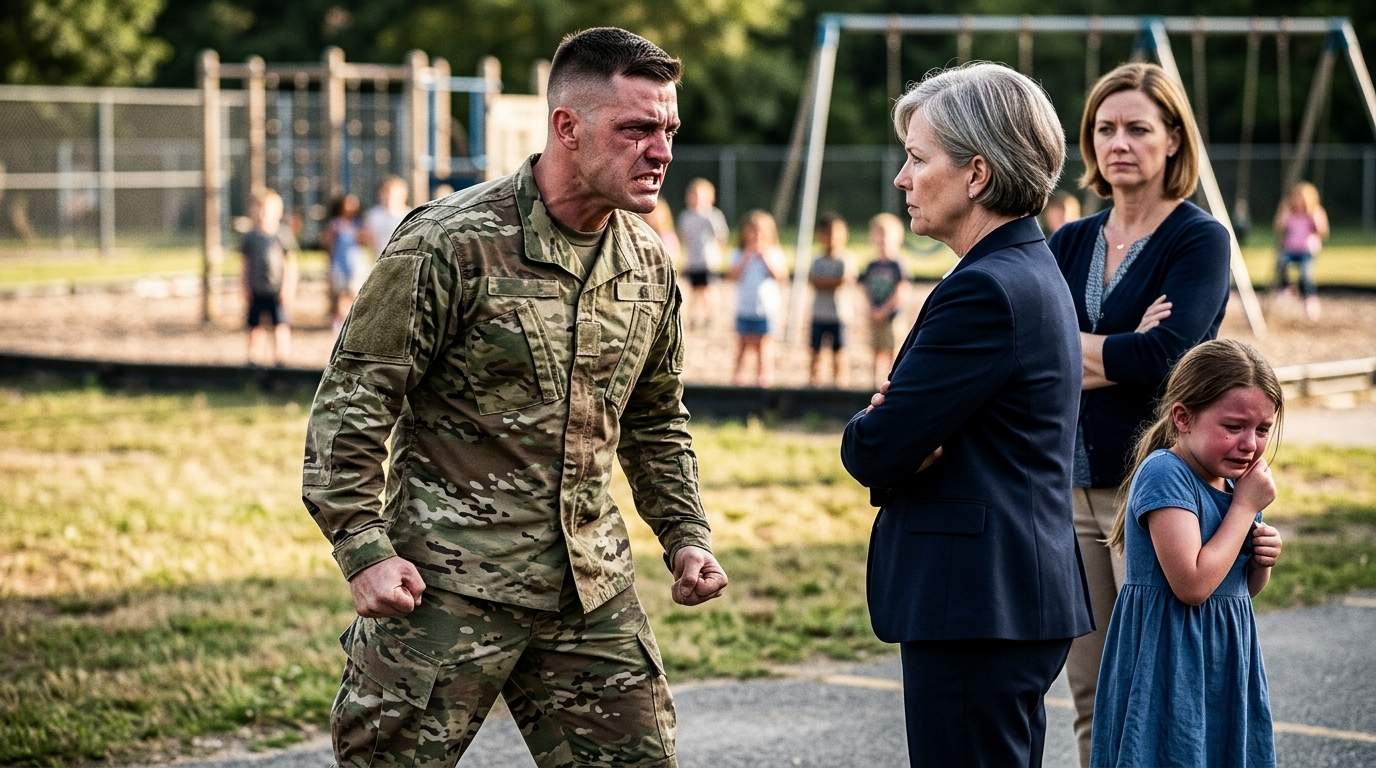
A few feet away stood Ms. Davison, her teacher.
And Mrs. Clark, the principal.
Their posture was stiff.
Their faces unreadable from a distance.
But I knew.
Instinct screamed at me.
Something was terribly wrong.
I started moving, faster now.
Past the smiling parents.
Past the oblivious children.
My uniform felt heavier than usual.
I called her name, "Sarah!"
It came out as a strained rasp.
She flinched.
Like she was caught.
Like she was doing something bad.
She finally turned.
Her little face was blotchy, tear-streaked.
Her eyes, usually so full of light, were puffy and red.
Drained of all color.
A silent scream tore through my chest.
My little girl looked utterly shattered.
Ms. Davison and Mrs. Clark turned too.
No surprise on their faces.
No warmth.
Just that same stiff, impassive expression.
Mrs. Clark even sighed.
A quiet, irritated sigh.
Like I was late for a parent-teacher conference I didn't know about.
Not like I was a father seeing his daughter in distress for the first time in a year.
The rage started then.
A low thrum in my ears.
A cold certainty in my gut.
I reached them, my voice tight.
"What's going on?" I asked, looking from my daughter's bowed head to their stern faces.
Ms. Davison stepped forward, blocking my view of Sarah slightly.
"Mr. Thompson," she said, her voice flat, devoid of any empathy.
"We've had an incident with Sarah again."
Again.
The word hung in the air.
Like a judgment.
Like a dismissal.
My daughter, still sobbing quietly, recoiled a little at the word.
"An incident?" I repeated, my voice rising despite my efforts to control it.
"She's crying her eyes out. What kind of incident?"
Mrs. Clark finally spoke, her voice equally measured, equally cold.
"Sarah had another outburst, Mr. Thompson. A very disruptive one. In the middle of the playground."
"Outburst?" I looked at Sarah.
She was burying her face in her hands now.
Trying to disappear.
"She doesn't have 'outbursts'," I said, the words tasting like ash.
"Sarah has sensory overload sometimes. You know this. We've talked about her autism."
Ms. Davison scoffed.
A quiet, almost imperceptible sound.
But I heard it.
My vision tunneled.
"We understand her diagnosis, Mr. Thompson," Mrs. Clark interjected, her tone now defensive.
"But we cannot allow her to disrupt the entire school day for other children. Or be a danger to herself."
"Danger?" I was shouting now.
"She's eight years old! She's crying because she's overwhelmed! Where is the 'danger'?"
Other parents were openly staring.
Kids had stopped playing.
The silence was deafening.
Sarah whimpered.
"She was screaming," Ms. Davison said, her voice hardening.
"Refused to calm down. Thrashing. We had no choice but to isolate her until you arrived."
Isolate.
That word hit me like a physical blow.
My little girl.
Alone.
Screaming.
And they stood by.
Watching.
Judging.
"Isolate her?" I whispered, my voice raw with disbelief.
"That's your solution for a child with special needs having a meltdown? Public shaming?"
Mrs. Clark puffed herself up.
"We were following protocol, Mr. Thompson. For the safety and well-being of all students."
"Protocol?" I stepped past Ms. Davison, kneeling down to Sarah.
She was shaking like a leaf.
"Hey, baby girl," I murmured, my voice breaking.
"It's okay. Daddy's here. I'm here."
She looked up, her eyes wide with fear.
"Daddy, I just… the bells. They were too loud. And Michael pushed me. And the sun… it was too bright."
Her small voice was barely audible.
My heart shattered into a million pieces.
It was exactly what I’d told them could happen.
It was sensory overload.
Not an "outburst."
Not a "danger."
Just a little girl, overwhelmed.
And instead of kindness, she got coldness.
Instead of help, she got isolation.
I stood up slowly, facing the two women again.
My hands were balled into fists.
My whole body was trembling with an anger so deep, so profound, it stole my breath.
I had seen war.
I had seen true horror.
But the quiet, systemic cruelty directed at my daughter…
That was a different kind of monster.
"You think this is okay?" I asked them, my voice barely a growl now.
"You think isolating a child with autism, making her feel like a pariah for her condition, is 'protocol'?"
Mrs. Clark's face went crimson.
"We did what was necessary!" she insisted.
"Perhaps you don't understand the challenges we face with children like Sarah."
"Children like Sarah?" I repeated, the words a bitter poison on my tongue.
"She's not a 'challenge.' She's my daughter. And you just broke her heart."
I scooped Sarah into my arms.
She clung to me, her small hands digging into my uniform.
"This isn't over," I said, looking from Mrs. Clark to Ms. Davison.
"Not by a long shot."
I turned, carrying my sobbing daughter away.
But as I walked, I heard Mrs. Clark say, just loud enough for me to hear over Sarah's cries, "Honestly, some parents..."
Some parents.
The implication hung in the air like a foul stench.
That I was the problem.
That Sarah was the problem.
After everything.
After all the emails, all the meetings, all the explanations about her needs.
It felt like they hadn't heard a single word.
Or worse.
They simply didn't care.
I wonder if they truly believed they were doing the right thing.
Or if it was just easier for them to label her, punish her, and dismiss her…