The sound of paper tearing echoed through our living room, and I knew something terrible was happening before I even reached the doorway.
My name is Eleanor Whitmore, and for nearly forty years, Arthur Bennett had been the most loyal man in our household.
He had served my late husband, raised our son Edward through childhood, and stood beside me through every funeral, financial crisis, and family scandal.
He was never merely our butler.
He was the one person I trusted to tell me the truth, even when everyone else was afraid to speak.
Yet when I stepped into the living room that afternoon, I found him on the floor beside the fireplace, desperately gathering pieces of an old photograph while my son stood over him.
Edward held the torn frame in one hand and wore the same arrogant expression I had seen too often since his father's death.
His expensive dark suit was immaculate, his gold wristwatch gleamed beneath the chandelier, and his face showed no trace of remorse.
"Forty years is long enough," he snapped at Arthur. "You're fired!"
Arthur looked up at him, his silver hair disheveled and his hands trembling.
"Please, Edward. You can take my position, my room, and everything else, but not that photograph."
Edward laughed bitterly.
"You're nothing in this house anymore."
Then he shoved Arthur's old suitcase toward the fireplace.
A few worn shirts spilled onto the carpet, and Edward kicked them aside as though they were garbage.
I froze.
I had known my son could be cruel when he wanted something, but I had never imagined he would humiliate an elderly man who had devoted almost his entire life to our family.
Arthur struggled to his feet and reached for the photograph.
Edward shoved him again.
This time, Arthur lost his balance and fell hard onto the carpet.
The broken pieces scattered around him.
"Stop!" I shouted.
Both men turned toward me.
But before either could speak, I noticed something lying between Arthur's hands.
It was a piece of the old black-and-white photograph, its edges yellowed with age.
The picture showed Arthur standing outside our mansion decades earlier, beside my husband, Richard, and me.
I remembered that photograph.
It had been taken shortly after our son's first birthday, during a summer celebration at the estate.
Arthur had treasured it for years, keeping it in a small wooden box in his private quarters.
I had never understood why that particular picture meant so much to him.
Now I was about to discover the reason.
I crossed the room and knelt beside him.
"Arthur, are you hurt?"
He shook his head, though pain flickered across his face.
"Please, Mrs. Whitmore. Let me have it."
His voice was so desperate that I stopped reaching for the photograph.
Instead, I picked up the piece lying face down on the carpet.
Something had been written on the back in faded blue ink.
The handwriting was unmistakably familiar.
My breath caught as I read the sentence.
"Arthur is the rightful father of my firstborn."
For several seconds, I couldn't understand the words.
Then I read them again.
And again.
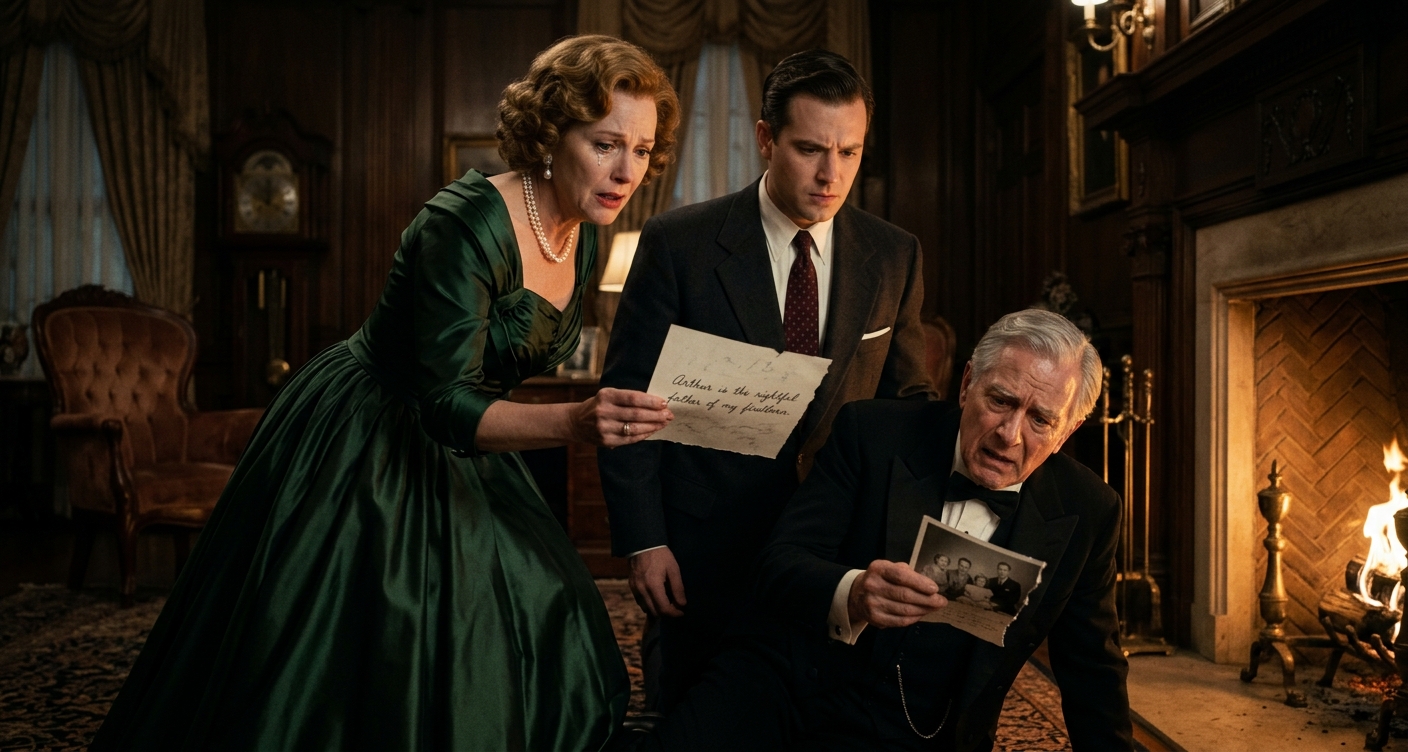
The room seemed to tilt around me.
I knew that handwriting.
It belonged to my husband.
Richard had written those words decades ago, when our marriage was still young and our son was barely old enough to walk.
I pressed the photograph against my chest, struggling to breathe.
Edward stared at me.
"Mother, what is that?"
I couldn't answer.
My gaze shifted from the handwriting to Arthur's face.
He was looking at me with the expression of a man who had spent forty years carrying a secret that had finally become impossible to hide.
"No," I whispered.
Arthur lowered his eyes.
That small movement told me more than any explanation could have.
I stood slowly, gripping the photograph so tightly that the torn edges dug into my palm.
"Edward," I said, "did you know about this?"
His face turned pale.
"Know about what?"
I held the photograph toward him.
He glanced at the writing, then immediately looked away.
That was when I understood that my son was not simply frightened by the accusation.
He was frightened because he recognized the truth.
"Edward," I repeated, my voice trembling, "answer me."
He stepped toward me.
"Mother, I can explain."
"Then explain!"
He opened his mouth, but no words came.
Arthur struggled to his knees.
"Mrs. Whitmore, please. This is not how I wanted you to find out."
I turned toward him.
"Find out what?"
He looked at Edward, then back at me.
"Richard was not Edward's biological father."
The words landed like a physical blow.
I staggered backward and caught the edge of the sofa.
For nearly thirty-three years, I had believed Edward was the child Richard and I had brought into the world together.
I remembered the difficult pregnancy, the long night in the hospital, and Richard holding our newborn son while tears streamed down his face.
I remembered the pride in his voice when he announced the birth to our relatives.
Had every one of those memories been built on a lie?
I looked at Arthur.
"Are you telling me that you are Edward's father?"
His eyes filled with tears.
"Yes."
Edward suddenly seized the remaining photograph pieces from the carpet.
"That's enough!"
He tore through them with shaking hands, destroying what was left of the image.
But the gesture only made the truth more obvious.
He had not been shocked by the revelation.
He had been trying to prevent it.
I turned toward my son.
"How long have you known?"
Edward said nothing.
"How long?"
"Since last month," he finally muttered.
I stared at him.
"Last month?"
He ran a hand through his carefully styled hair.
"I found Father's private papers while reviewing the estate accounts. There were letters, medical records, and a sealed envelope addressed to you."
"Where are those papers?"
He looked toward the fireplace.
My stomach dropped.
"You burned them?"
"I had to!"
His voice rose so sharply that Arthur flinched.
"If anyone found out, everything would change!"
I could barely recognize him.
"What exactly would change, Edward? Your inheritance?"
He clenched his jaw.
"Don't pretend you don't understand."
And suddenly, the pieces began falling into place.
Since Richard's death six months earlier, Edward had been obsessed with gaining complete control of the family estate.
He had dismissed two longtime employees, sold several valuable antiques without consulting me, and attempted to transfer ownership of our country properties into a company registered under his name.
Whenever I questioned him, he accused me of being too emotional to manage the family's affairs.
He had even suggested that I move into a smaller residence so he could renovate the mansion.
I had mistaken his behavior for grief mixed with ambition.
Now I realized he had been racing against a secret that threatened everything he believed he deserved.
I looked down at the photograph.
"Why would your father write this?"
Arthur took a slow breath.
"Because Richard wanted the truth recorded, even if he was too afraid to reveal it publicly."
He explained that he and I had become close long before Edward was born.
I had been lonely in my marriage, and Richard had spent most of his time pursuing business opportunities and social connections.
Arthur had been the person who listened when I cried, the one who sat with me when my mother died, and the one who reminded me that I was more than a wealthy man's wife.
Our friendship crossed a line during a brief period when Richard and I were separated.
When I discovered I was pregnant, Richard and I had already reconciled.
I told myself there was no reason to reopen old wounds.
Richard knew there was a possibility Edward was not his biological child, but he chose to raise him as his own.
Arthur agreed to remain silent because he believed Edward deserved a stable childhood and because I begged him not to destroy my marriage.
For years, I convinced myself that our decision had protected everyone.
Now I understood the cost of that silence.
Arthur had watched the boy he loved grow into a man who treated him as disposable.
And Edward had built his identity around a legacy that might not have been his by blood.
I sank onto the sofa.
"Why didn't you tell me Richard had written this?"
Arthur looked toward the fireplace.
"I tried to speak with him shortly before he died. He said he wanted to tell you himself."
His voice broke.
"But he never got the chance."
I pressed my fingers against my temples.
Richard had been ill for months before his death, and during that time, he had become increasingly anxious about the estate.
I remembered him asking me to promise that I would never let Edward make certain decisions without independent legal advice.
At the time, I assumed he was worried about our son's inexperience.
Now I wondered whether he had been trying to protect me from the very man I had raised.
Edward paced in front of the fireplace.
"This changes nothing," he insisted.
I looked up.
"Nothing?"
"I'm still the son you raised. I'm still the heir."
"Being my son doesn't give you permission to destroy another person's life."
His face hardened.
"Arthur has no claim to this house."
"Perhaps not," I replied. "But he has given this family more than you ever have."
Edward laughed without humor.
"That's sentimental nonsense."
Then he made his biggest mistake.
He pointed at Arthur and said, "He's just a servant. He should be grateful we let him stay here."
Arthur lowered his head.
I saw the hurt in his eyes, and something inside me finally broke.
"Get out," I said.
Edward stared at me.
"What?"
"Leave this room."
"This is my house!"
"No," I replied. "It is my house, and you will not speak to Arthur like that again."
For the first time in his life, my son looked genuinely uncertain.
He turned toward the doorway, but before leaving, he leaned close to me.
"You have no idea what you're risking."
I watched him walk away.
Then I turned to Arthur.
"Tell me everything."
He hesitated before explaining that Richard had discovered more than the question of Edward's parentage.
The sealed documents Edward had found contained evidence that our son had been using forged authorizations to sell family assets and redirect money into his own accounts.
Richard had confronted him weeks before his death.
Edward had promised to stop.
Instead, the financial transfers had accelerated.
That explained why Edward had been so desperate to control the estate and why he had tried to destroy the old records.
The photograph had not merely exposed a family secret.
It had revealed the reason he was willing to humiliate the one man who could connect him to Richard's final wishes.
Arthur had been present when Richard prepared the documents.
He knew where the original records were hidden.
And Edward knew it.
I immediately called our family solicitor, Mr. Harrington, and asked him to come to the mansion.
When he arrived, I showed him the photograph and explained what Arthur had told me.
He listened without interrupting, then requested access to Richard's remaining files.
By the following morning, an independent accountant had begun reviewing the estate's finances.
Within a week, we discovered that Edward had attempted to transfer hundreds of thousands of dollars through a series of shell companies.
The solicitor froze the pending transactions and notified the appropriate authorities.
Edward was furious.
He accused me of betraying my own child and threatened to challenge every decision I made.
But his threats no longer frightened me.
The investigation eventually confirmed the financial misconduct, and Edward was forced to surrender his control over the disputed assets.
He also lost his position as the estate's managing director.
For the first time, he had to face consequences that money and family connections could not erase.
The question of his biological father was more complicated.
Arthur never demanded that Edward call him Dad.
He never asked for money or recognition.
He simply wanted the truth acknowledged.
Months later, after the estate dispute had been resolved, I arranged for a private meeting between them.
Edward arrived looking older than I remembered, his usual arrogance replaced by a guarded silence.
Arthur stood beside the window, dressed in the same neat black uniform he had worn for decades.
Neither man spoke at first.
Finally, Edward asked, "Why didn't you tell me?"
Arthur looked at him gently.
"Because I believed you deserved the chance to become your own man before you learned where you came from."
Edward swallowed.
"And now?"
"Now you must decide what kind of man you want to be."
My son looked away.
He did not apologize that day.
He did not embrace Arthur or suddenly become the loving son we had once hoped he would be.
Life rarely repairs a lifetime of cruelty in a single conversation.
But he stopped calling Arthur a servant.
He began addressing him by his name, and, eventually, he offered a quiet apology for what he had done in the living room.
Arthur accepted it without pretending the pain had disappeared.
As for me, I kept the surviving pieces of the photograph in a small frame on my desk.
I never tried to hide the torn edges.
They reminded me that the truth could be damaged, delayed, and buried beneath years of silence, but it could not be made harmless by pretending it did not exist.
For forty years, Arthur had protected our family at the expense of his own heart.
The least I could do was protect his dignity when the truth finally came out.
And the day my son learned that blood was not the same as entitlement, our family began to change.
Not because a secret had magically healed every wound.
But because, for the first time in decades, no one was allowed to destroy the truth simply because it was inconvenient.