I thought the old shoeshiner was nobody.
That was the mistake I would spend the rest of my life regretting.
It happened on a cold autumn morning in 1947, on a busy street in Manhattan, where black automobiles rolled past brick storefronts and newspaper boys shouted headlines beneath the iron streetlamps.
My name is Richard Whitmore, and at thirty years old, I had everything a man could want.
I wore tailored suits, carried an expensive watch, and worked for a Wall Street investment firm that handled the money of men far wealthier than myself.
I had learned to judge people by their appearance because, in my world, appearance opened doors.
That morning, I stopped beside an elderly shoeshiner named Samuel, who sat on a wooden stool with a battered toolbox at his feet.
His coat was worn, his hat was faded, and his hands looked stiff from years of working in the cold.
I glanced at my polished black shoes and dropped a coin beside his box.
"Make them shine," I ordered.
Samuel nodded without complaint.
He worked carefully, brushing away the dust before applying a thin layer of polish.
For a few minutes, I barely noticed him.
Then I saw a dark smudge near the edge of my trouser cuff.
I pulled my foot away.
"Look what you've done to my shoes!"
Samuel immediately looked up.
"I'm sorry, sir. Let me clean that for you."
But I was already irritated.
I had an important meeting that morning, and the last thing I wanted was to arrive with dirty trousers.
Instead of allowing him to fix the problem, I kicked his wooden toolbox.
It toppled onto the pavement, sending brushes, polish tins, and rags scattering across the sidewalk.
A metal tin rolled beneath a parked automobile.
Samuel stared at the mess for a moment.
Then he slowly bent down to retrieve his belongings.
"Stay out of my way, old man," I muttered as I straightened my cuffs.
A woman carrying groceries stopped to watch.
A newspaper boy lowered his stack of papers.
I noticed them looking at me, but I didn't care.
In my mind, I had simply put an insignificant man in his place.
Samuel said nothing.
He reached for a brush near the gutter, his fingers trembling in the cold.
There was something about his silence that made the moment feel uglier than it should have.
I turned to leave.
"Sir. Don't move."
The voice came from behind me.
I looked over my shoulder and saw a uniformed police officer approaching.
He was a broad-shouldered man in his forties, wearing a dark blue uniform and a traditional police cap.
His nameplate read MILLER.
I frowned.
"What's the problem, officer?"
Miller didn't look at me.
He was staring at Samuel.
Then he reached into his uniform and removed a small black-and-white photograph with worn, yellowed edges.
He studied the picture, looked at the old man, and studied it again.
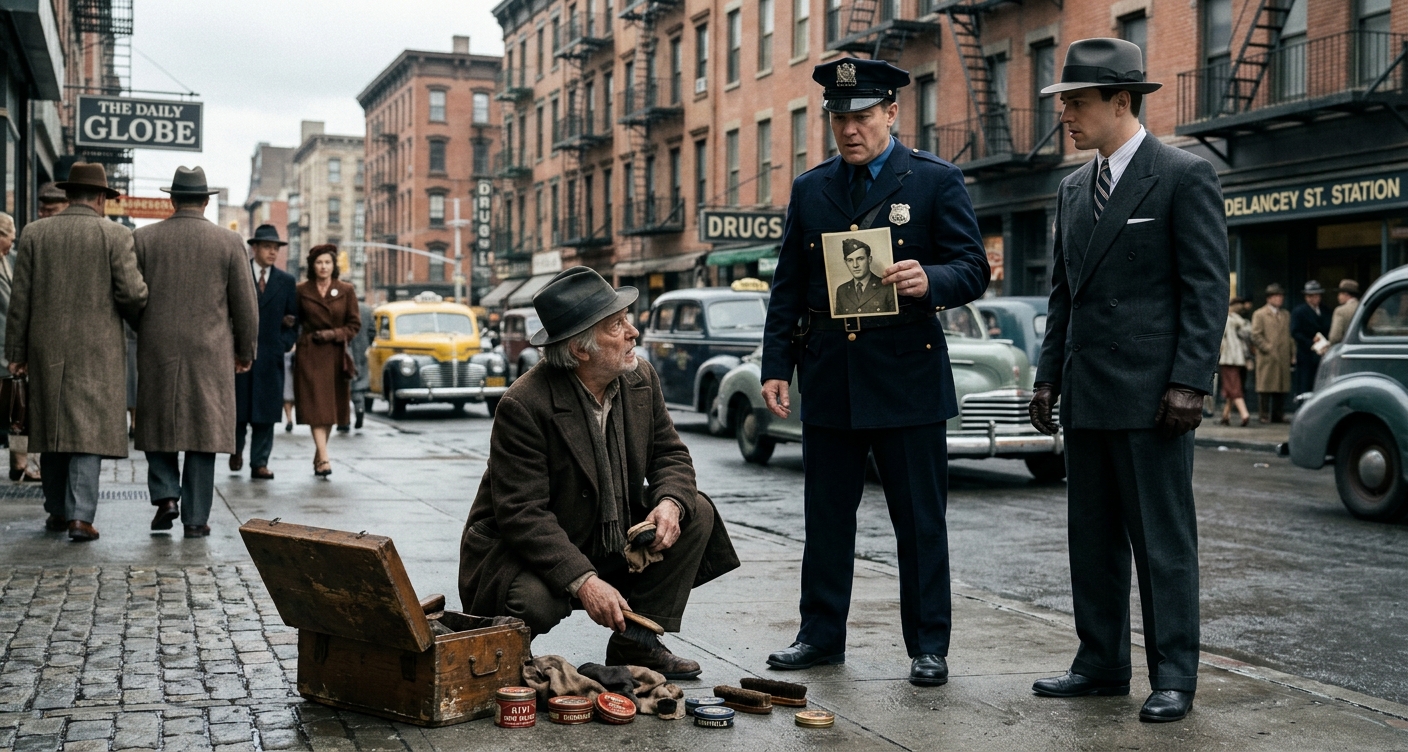
His expression changed so abruptly that I forgot about my shoes.
"Samuel?" he asked.
The shoeshiner stopped moving.
Miller stepped closer and held the photograph toward him.
"Is that really you?"
Samuel slowly raised his head.
His eyes fell on the picture.
The brush slipped from his fingers and landed on the pavement.
For the first time since I had approached him, the old man looked frightened.
Not confused.
Not surprised.
Frightened.
Miller's voice softened.
"We've been looking for you for years."
I stared at the two men.
"What is this?" I demanded. "Who exactly is he?"
Neither answered.
Samuel looked from the photograph to the officer's face.
Then he asked a question that made Miller go completely still.
"Who gave you that photograph?"
The officer glanced at me, then back at Samuel.
"I can't explain everything here," he said. "But someone finally came forward."
Samuel swallowed hard.
"After all this time?"
"Yes."
The old man looked down at the scattered tools surrounding his feet.
For a moment, I thought he might cry.
Instead, he reached for his battered hat and held it tightly against his chest.
Miller crouched beside him.
"Samuel, I need you to come with me. There's someone who wants to see you."
Samuel didn't move.
"Is he alive?"
The officer hesitated.
That single pause told me the answer mattered more than anything else in the world.
"Yes," Miller finally said. "He's alive."
Samuel shut his eyes.
A tear slipped down the deep lines of his face.
I stood there, completely bewildered.
Whoever this man was, he had apparently been missing for years, and a police officer had just found him shining shoes on a Manhattan sidewalk.
I looked at the photograph again.
It showed a young man in a military uniform, standing beside a stone building.
He had dark hair, a straight nose, and a small scar above his left eyebrow.
The resemblance to Samuel was unmistakable.
It was the same face, only decades younger.
I suddenly felt ashamed of how I had treated him.
But shame wasn't the only thing I felt.
Curiosity began eating at me.
"Officer," I said, trying to recover my usual confidence, "if this is some kind of investigation, I don't see why you stopped me."
Miller rose to his feet.
"I didn't stop you because of the shoeshiner."
"Then why?"
"Because I need to ask you a few questions about what happened here."
I glanced at the broken toolbox.
"That was a private disagreement."
"No," Miller replied. "It happened on a public sidewalk, in front of witnesses."
His tone was calm, but there was no mistaking the warning.
For the first time that morning, I realized that my money and my tailored suit wouldn't necessarily make this conversation go my way.
Still, the officer's attention soon returned to Samuel.
He helped the old man gather the remaining brushes and place them back inside the wooden box.
When he reached for the polish tin beneath the parked car, Samuel stopped him.
"Leave that one," the old man said quietly.
Miller looked puzzled.
Samuel's gaze remained fixed on the photograph.
"I've spent years trying to forget what happened. If you're telling me the truth, I need to know why you're here now."
Miller folded the photograph carefully.
"Because the man who took this picture has finally agreed to tell us what he knows."
Samuel's face grew pale.
"Then he knows where the others went."
The officer didn't answer.
That silence was enough to make my skin prickle.
I had spent my life around powerful men who hid their intentions behind polite smiles.
I knew what it looked like when someone was afraid of the truth coming out.
Samuel looked like a man who had carried a terrible secret for decades.
And Miller looked like a man who had just discovered that the secret was still alive.
I took a step closer.
"What others?"
Miller turned toward me.
"That isn't your concern, Mr. Whitmore."
I stiffened.
I hadn't told him my name.
He nodded toward the initials engraved on my silver cigarette case, which had fallen from my pocket when I kicked the toolbox.
Then he picked it up and handed it to me.
"Perhaps you should be more careful with your belongings."
I took the case without speaking.
Samuel watched the exchange with an expression I couldn't read.
Then his eyes settled on my face.
"Whitmore," he repeated softly.
Something changed in his voice.
I stared at him.
"Do you know my family?"
He looked down at the photograph again.
For a long moment, he said nothing.
Then he placed one trembling finger against the image of the young soldier.
"I knew your father."
The street seemed to grow quieter around us.
My father had died when I was twelve.
He had been a decorated veteran, a respected businessman, and a man whose reputation had followed me into every room I entered.
He rarely spoke about the war.
Whenever I asked him about his military service, he would tell me that some memories were better left buried.
I had always assumed he meant the horrors of battle.
Now an elderly shoeshiner was telling me he had known him.
"That's impossible," I said.
Samuel lifted his eyes.
"Your father was the reason I disappeared."
I felt the blood drain from my face.
Miller immediately stepped between us.
"Samuel, we need to take this somewhere private."
But the old man shook his head.
"No. He deserves to know what kind of man his father really was."
I wanted to demand an explanation.
I wanted to tell Samuel that he knew nothing about the man who had raised me.
Yet I couldn't make myself speak.
Because I remembered something I had spent years trying to forget.
The night before my father died, I had heard him arguing with a visitor in his study.
I had crept down the staircase and listened from behind the door.
One voice belonged to my father.
The other was unfamiliar.
The visitor had said, "You promised the family would never find out."
My father had answered, "I did what I had to do."
Then I heard a glass break.
When I entered the room the following morning, the study had been cleaned, the broken glass was gone, and my father had told me never to mention the conversation again.
For years, I had obeyed him.
Now I looked at Samuel and understood that the past I had inherited might be very different from the one I had been told.
"Tell me what happened," I said.
Samuel glanced at Miller.
The officer gave a reluctant nod.
"Not here," Samuel replied. "Not until I know who else is listening."
He looked toward the black automobile parked across the street.
A man in a dark overcoat sat behind the wheel, watching us.
When he realized Samuel had noticed him, he started the engine.
The automobile pulled away from the curb and disappeared into traffic.
Miller's expression hardened.
He reached for his radio.
Samuel grabbed his sleeve.
"Don't chase him."
"Why not?"
"Because if he's the man I think he is, he'll lead you to the others."
Miller stared at him.
"Samuel, what happened forty years ago?"
The old man took a shaky breath.
Then he turned to me.
"Your father wasn't the hero you believe he was, Richard."
I felt as though someone had struck me.
Samuel continued before I could respond.
"During the war, he and three other men were entrusted with something that could have ruined several powerful families. When the men began disappearing, I was blamed for stealing the evidence."
"Why would my father do that?"
"Because he knew I had the original records."
Miller slowly unfolded the photograph again.
On the back, beneath a faded date, were four handwritten names.
One was Samuel's.
Another was my father's.
The third had been scratched out so aggressively that the paper was nearly torn.
The fourth was still legible.
Miller read it aloud.
"Edward Whitmore."
My grandfather.
I stumbled backward.
My family had always claimed that Edward died overseas during the war.
But Samuel looked at me with the certainty of a man who had waited too long to speak.
"Your grandfather didn't die in combat," he said. "He vanished the night your father signed the report that sent me away."
I stared at the photograph.
The officer's hand tightened around its worn edges.
"Samuel," Miller said quietly, "if what you're telling us is true, this goes far beyond a missing person."
The old man nodded.
"That's why I stayed hidden."
I looked from Samuel to the officer, then back at the faded image of the young soldier.
My father had spent his life teaching me that reputation was everything.
He had taught me to dress well, speak confidently, and never let anyone see weakness.
That morning, I had repeated his lessons by humiliating an old man who could barely afford to replace a tin of shoe polish.
Now I wondered whether the arrogance I had mistaken for strength was simply another family inheritance.
Samuel picked up his wooden toolbox.
Miller offered to carry it, but the old man refused.
"I've carried it this long," he said. "I can carry it a little farther."
Then he turned toward the waiting police car.
Before he climbed inside, he looked at me one final time.
"Your father left you a letter, Richard. If it's still where he hid it, you'll understand why I never came back."
My heart pounded.
"Where?"
Samuel opened the car door.
"Under the floorboards of his old study."
The door shut.
The police car pulled away, leaving me alone on the pavement with my expensive shoes, my silver cigarette case, and a past I no longer understood.
I looked down at the place where Samuel's toolbox had been.
A few drops of shoe polish remained on the wet stone.
For the first time in my life, I wished I had been the one kneeling on the sidewalk.
Because the old man I had treated like nothing had just revealed that everything I believed about my family might have been a lie.
And somewhere beneath the floorboards of my father's study, the truth was still waiting.