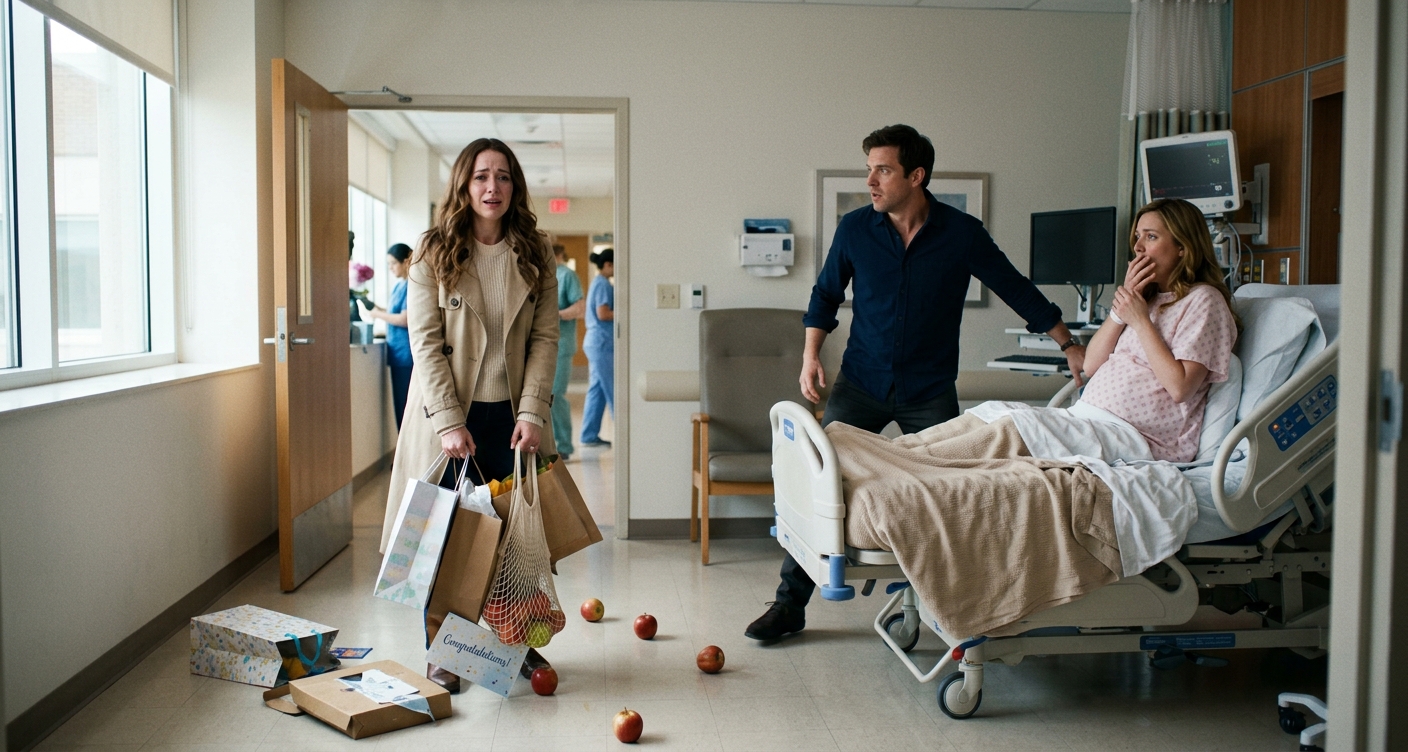
The moment I pushed open the hospital room door, my husband was kissing my best friend.
I stood frozen in the doorway, a bag of fresh apples dangling from one hand and a gift box tucked beneath my other arm, watching Ryan lean over Sophia’s hospital bed with a tenderness I had never imagined he would give another woman, much less the woman who had stood beside me on my wedding day.
For a few seconds, neither of them noticed me.
Then the apple bag slipped from my fingers, hit the floor, and sent red apples rolling across the polished hospital tiles.
Ryan jerked away from Sophia so quickly that his hip struck the bedside table, rattling a plastic cup of water.
Sophia’s hand flew to her mouth.
“Emily,” Ryan stammered, staring at me as though I had appeared out of thin air.
I looked at him, then at her swollen belly beneath the pale pink hospital gown, and finally at the gift I had brought for the baby she was about to deliver.
“You were kissing my best friend,” I said, my voice trembling. “In a hospital room. While she’s carrying someone else’s child?”
Ryan hurried toward me with both hands raised.
“Please, wait. It’s not what you think.”
I had heard those words in movies, in gossip exchanged over coffee, and in stories told by women who swore they had never seen the betrayal coming.
I had always wondered how anyone could say something so ridiculous after being caught with their lips on someone else’s.
Now I knew the answer.
People said it because the truth was too ugly to face.
“Don't ever touch me again,” I snapped when Ryan reached for my arm, slapping his hand away before turning toward the corridor.
I left the apples, the gift, and the two people who had just destroyed the life I thought I knew.
What Ryan didn't understand was that the kiss itself wasn't the worst part.
It was everything that had happened before it, and everything I would discover afterward.
My name is Claire Bennett, and I had known Emily Carter since we were seventeen.
We met during our first week of high school when Emily sat beside me at lunch after hearing another girl make fun of my secondhand clothes.
She didn't know me, didn't owe me anything, and could easily have stayed with the popular crowd.
Instead, she dropped her tray onto the table and said, “If you're going to be cruel, at least be interesting.”
That was Emily.
She was fiercely loyal, sometimes stubborn to a fault, and the sort of person who remembered your coffee order years after you had forgotten telling her.
When she met Ryan Miller at a friend's Fourth of July barbecue, I was the first person she called.
“He actually listens when I talk,” she told me, sounding almost embarrassed by how happy she was.
Ryan seemed perfect for her at first.
He was charming without being flashy, worked as a commercial property manager, and remembered to bring her favorite pastries when she had a difficult day.
At their wedding, I held Emily's bouquet while she cried through her vows, promising to stand beside her through every ordinary morning and every unexpected storm.
I believed those promises meant something.
When Sophia became pregnant nine months ago, Emily was thrilled.
Sophia had been her closest friend from college, the person she called whenever life became complicated, and the woman Emily trusted enough to name as godmother to the baby.
The pregnancy hadn't been easy.
Sophia had suffered severe morning sickness, several frightening hospital visits, and weeks of anxiety after doctors warned her that the final trimester required extra monitoring.
Emily showed up for all of it.
She drove Sophia to appointments when her boyfriend, Daniel, was away on business, assembled a crib in Sophia's apartment, and spent entire evenings comparing baby monitors and tiny winter coats.
When Sophia was admitted for observation shortly before her due date, Emily immediately offered to visit.
She even arranged to leave work early, stopping at a grocery store to buy the crisp apples Sophia loved and a soft knitted blanket for the baby.
That was why she had been smiling when she entered the hospital room.
She thought she was bringing comfort to someone she loved.
Instead, she found two people who had apparently decided her trust was something they could spend without consequence.
I didn't follow Emily into the corridor immediately.
I was standing near the nurses' station when I heard hurried footsteps behind me.
Ryan came around the corner, his face flushed and his shirt collar crooked.
“Claire, please,” he said. “You have to help me talk to her.”
I stared at him.
“Help you? You just betrayed your wife with her pregnant best friend.”
“It was a mistake.”
“How many mistakes does it take to get your mouth on someone else's?”
He looked down the corridor toward the elevators.
“It's complicated.”
“No, Ryan. Complicated is a medical diagnosis. This is a choice.”
His jaw tightened, and for the first time since I had known him, I saw something beneath his usual polished charm.
Not remorse.
Fear.
He glanced toward the maternity ward doors, then lowered his voice.
“Emily doesn't know everything.”
I felt a chill move through me.
“What does that mean?”
He rubbed both hands over his face and said that Sophia had been calling him for weeks, that their conversations had started because she was frightened about the baby, and that one thing had somehow led to another.
He insisted the kiss was the first time they had crossed a physical line.
I didn't believe him.
I had watched Emily spend months reassuring Sophia that she wasn't alone, while Ryan repeatedly claimed he was too busy to accompany his wife to dinner or help prepare their spare bedroom for guests.
At the time, those things had seemed like ordinary disappointments in a marriage under strain.
Now they looked like pieces of a picture I had refused to assemble.
“Tell her the truth,” I said.
“I will. Just give me a chance to explain it properly.”
“You had your chance every day you lied to her.”
I walked away before he could answer.
I found Emily in the hospital parking garage, sitting in her car with both hands gripping the steering wheel.
She hadn't started the engine.
Her face was wet, but she wasn't making a sound.
I climbed into the passenger seat and waited.
Finally, she whispered, “I brought her a blanket.”
I looked at the gift bag on the floor between us.
“I know.”
“I spent three hours choosing it because I wanted the baby to have something special.”
Her voice cracked on the last word.
I reached for her hand, and she squeezed mine so tightly that my fingers hurt.
Then she turned toward me with an expression I had never seen on her face before.
“Claire, what if this has been happening for months?”
I didn't offer the easy reassurance that Ryan had given me.
“I think you deserve to know the answer.”
That evening, Emily went home without speaking to Ryan.
He sent dozens of messages, alternating between apologies, explanations, and requests that she not make any decisions while she was upset.
When she didn't respond, he called me again.
I declined the call.
The next morning, Emily told me she had checked their shared phone account.
There were dozens of calls between Ryan and Sophia, many occurring late at night when Emily believed her husband was working overtime.
Some lasted only a few minutes.
Others continued for nearly an hour.
Then Emily found a hotel receipt in Ryan's email, dated six weeks earlier, for a room booked near Sophia's apartment.
There was no message explaining it, no convenient misunderstanding to rescue him, and no reason for a married man to have hidden it from his wife.
Emily didn't cry when she showed me the receipt.
She simply stared at the screen and said, “He didn't just betray me yesterday. He let me keep trusting him afterward.”
That was the moment her grief began turning into something steadier.
She contacted a marriage counselor to arrange an individual appointment, spoke with an attorney about her options, and asked Ryan to stay somewhere else while she considered what she wanted.
She also refused to let him rewrite the story as a moment of weakness caused by stress.
Sophia, meanwhile, sent a long message claiming that she had developed feelings for Ryan during the pregnancy and had convinced herself that Emily's marriage was already falling apart.
She apologized repeatedly, then added that she hoped Emily would understand because she was about to become a mother herself.
Emily read the message twice.
Then she replied with one sentence.
“You don't get to use your baby to excuse what you chose to do.”
She blocked Sophia afterward.
Two days later, Ryan arrived at Emily's house carrying flowers and a folder of printed photographs from their wedding.
He stood on the porch for nearly twenty minutes, insisting that their marriage was worth saving and that he would spend the rest of his life earning back her trust.
Emily opened the door but didn't invite him inside.
“You keep telling me you love me,” she said. “But every time you had a chance to protect that love, you chose to protect yourself instead.”
Ryan's eyes filled with tears.
“I can fix this.”
“No,” she replied quietly. “You can change yourself. You can become a better man. But you don't get to decide whether I stay long enough to see it.”
She placed his wedding ring, which he had left on the kitchen counter, into his palm.
Then she closed the door.
The weeks that followed were not as satisfying as the dramatic ending Emily had once imagined for herself.
There were legal appointments, difficult conversations with family members, and mornings when she woke up reaching for someone who no longer belonged beside her.
She had to tell her parents what happened, cancel a planned anniversary trip, and untangle shared financial arrangements she had never expected to question.
Ryan continued asking for another chance, but Emily stopped answering every message.
She learned that leaving a marriage did not instantly remove the love that had once made it feel safe.
It simply meant she was no longer willing to sacrifice her dignity to preserve the appearance of that safety.
When Sophia gave birth to a healthy baby boy, Emily heard the news through a mutual friend.
For a long time, she sat with her phone in her lap, remembering the tiny blanket she had bought and the excitement she had felt outside that hospital room.
Then she put the phone away.
She didn't send a congratulatory message, and she didn't ask to meet the baby.
That wasn't cruelty.
It was a boundary she needed in order to heal.
Months later, I accompanied Emily to a small apartment she had rented across town.
Sunlight poured through the living room windows, illuminating half-open boxes and a kitchen table that was still missing two chairs.
She had painted the bedroom a warm cream color and hung photographs from our teenage years along the hallway.
For the first time in months, she laughed without immediately looking guilty for feeling happy.
While we unpacked a box of dishes, she found a small card she had written for Sophia's baby shower.
The message promised that she would always be there for the child, no matter what life brought.
Emily read it silently, folded it in half, and placed it in the recycling bin.
“I thought being a good person meant never giving up on people,” she said.
I leaned against the counter.
“Sometimes being a good person means knowing when someone has given you every reason to walk away.”
She considered that for a moment, then nodded.
Ryan eventually moved to another city for work, and the divorce proceeded without the grand courtroom showdown he had once feared.
There was no magical punishment that erased what he had done.
He lost his marriage, the trust of friends who had believed in him, and the future he had assumed would remain his simply because he wanted it.
Sophia faced the consequences of her own choices, too, including the end of a friendship that had once felt like family.
Emily never celebrated their pain.
She didn't need to.
A year after the hospital incident, we returned to the same grocery store where she had bought the apples.
She picked up a bag of them, examined the bruises on a few near the bottom, and laughed when one slipped from her hand and rolled down the aisle.
For a split second, neither of us spoke.
Then Emily bent down, retrieved it, and placed it back in the bag.
“I used to think that day was the moment my life fell apart,” she said as we headed toward the checkout.
“What do you think now?”
She looked at me, her expression calm in a way I had never seen before.
“I think it was the moment I finally saw what my life was built on.”
Outside, she carried the groceries toward her car beneath a bright afternoon sky.
She was still healing, still learning to trust her instincts, and still discovering who she was without the people she had once considered permanent.
But she was no longer waiting for Ryan to explain why she deserved honesty.
She already knew she did.
And that, more than any slap, argument, or dramatic confrontation, was the beginning of her freedom.